Hey, everyone. I figured I should do a little 'Hello' spiel to any new faces and to anyone already involved who isn't familiar with me. I'm also going to tie in a little introduction to what the Feminism Society does and how it operates. Please note, anything I'm about to say does not necessarily represent the views of this society or any of its committee or members.
So. My name is Rose and I'm the 2013/14 FemSoc President. I study English and Classical Studies here at Royal Holloway, and I'm about to re-take my second year. Things I like: cake (you'll learn more about that during any events that require refreshments) photography, peppermint tea, writing, positive attitudes to mental health and gender equality. I also like trying to make a difference in areas of society I feel are problematic (mainly the last two. I don't worry too much about the representation about cake. Although... http://rhul-fem-soc.blogspot.co.uk/2013/01/food-guilt-societys-tool-to-make-you.html)
So, it was a bit of a no-brainer when I started here to try and get involved with things I thought were important within our SU (that's Student's Union.) I won't go into the inner dealings of GMs (General Meetings) Sabbs (Sabbatical Officers) and heated debates by way of microphone, because I don't want to overload you.
I got involved in second year, because I was too busy thinking I was a super awesome fresher in my first. At the beginning of my second year, I soon realised there were quite a few like-minded people within our union, and I started learning about some really important issues that hadn't really crossed my mind - trans* people's representation, BME representation and LGBT issues. Getting involved with the Feminism Society made me realise that every minorities representation in society interlinks, and it's important for us all to realise that.
For a while, like anything new, I was a little nervous about turning up to FemSoc events as I went by myself, but I can honestly say that now there are at least 6 members who are close friends. And I mean the kind of friends you Skype, not the ones you wave at awkwardly in Crosslands every now and again. So, FemSoc is friendly, and really welcoming. There were loads of great social events last year - we went out for meals, for drinks, hosted Come Dine With FemSoc (that also turned into an impromptu birthday celebration for me) went to SU club nights together and travelled into London for events, amongst others. There was a huge variation, and that's something we're going to continue doing next year - if you don't like clubbing or you don't drink alcohol, totally not an issue. We try to make sure every event is accessible, both in terms of disability and also atmosphere.
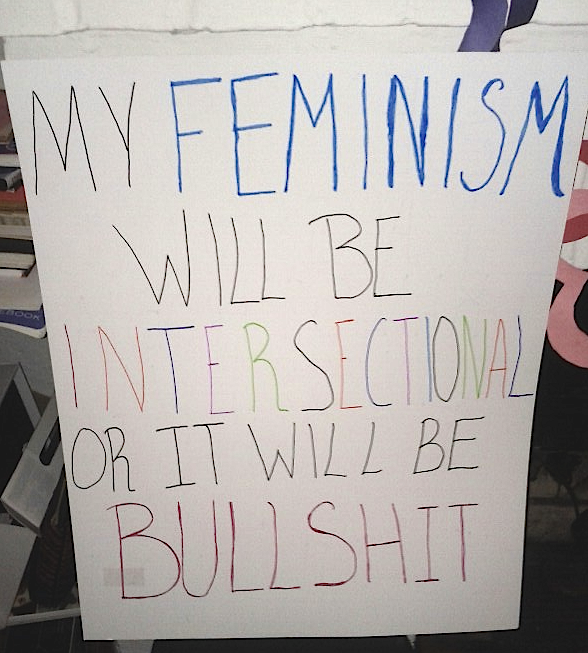
As well as social events, most of our sessions are designed to get our members thinking about Feminism as a whole, and also individual issues and how Feminism looks at them. Last year we talked about politics, diets, body hair, sex, porn, mental health, the representation of BME women in the media, Islam and Feminism amongst plenty more. Some sessions the society invited speakers to visit us and lead them, and others we would set up ourselves and just chat about. We also linked up and put on joint sessions with other societies, including the Islamic Society, the Afro-Caribbean Society, the Debating Society and the LGBT society. Like I said before, we work hard at being intersectional.
As well as discussions / presentation events, the society has also worked on campaigns that directly affect our University and its members. It's proposed and passed many motions at GMs (sorry if I've lost you here. I'll post a crib-sheet on Student's Union language at some point to ensure everyone understands why Twitter goes berserk every few weeks) that support other student women. For example, the society wrote to and offered our support to students at a University which was being targeted and harassed by anti-abortion activists, and did the same to a university finding it difficult to set up their own Feminist Society. On campus, we've worked with Sabbatical Officers and Students Union staff to ensure our SU is a zero tolerance union - put simply, it and its staff have a zero tolerance approach to sexual harassment. Sexual harassment is a huge issue within society, and university campuses don't escape that. We've helped implement an atmosphere that means there are ways of dealing with and reducing the occurrences of these issues, and that students feel comfortable reporting anything.
I plan on writing another post within the next couple of weeks about why I think Feminism is still so important in our world today; there's way too much to include within this. I hope this has been an interesting overview about the society and the kind of things it does - if you have any other questions relating to the society, feel free to send me or any of the committee a message or post in our Facebook group. It would be great to see a lot of new faces in September - I hope this post has sufficiently piqued your interest.
Oodles of feminist love,
Rose Walker
This is the official blog of the Feminism Society of Royal Holloway University of London.To join our mailing list or submit an article, feel free to email rhulfeminism@gmail.com. To pay your society membership please visit www.su.rhul.ac.uk
Showing posts with label RHUL FEM SOC. Show all posts
Friday, 9 August 2013
2013/14 President Says Hello
Labels:
campaign,
feminism,
motions,
RHUL FEM SOC,
student unions,
surhul,
zero tolerance
Sunday, 20 January 2013
Back to Uni with Rhul Fem Soc
We kicked things off with our welcome back FemStars Social. Thank you to all who came, if you didn't make it there are more socials coming up this month so stay tuned though the email list. If you want to be put on the mailing list please email us at rhulfeminism@gmail.com.
One of the great things about FemSoc is the fact that many of us get involved in student activism at Royal Holloway. This fine tradition contiued at Tuesday's General Meeting where Susuana, Rose and Hodan were elected to represent Royal Holloway at NUS Women's Conference. Fem Soc member Jack Saffery-Rowe was also elected to be a delegate for the NUS LGBT Conference.

Our first session of the year was on Diets and the gendered marketing of dieting. It was a very interesting discussion, covering things from Thin Spo, body ideals in different cultures, to pushy family members, peer pressure and Gok Wan. Another thing we also talked about briefly was eating disorders and what can cause them and how people can recover from them. We didn't have the time or the resources to discuss this in depth, however if you'd like to discuss issues like this you maybe interested in getting involved in the upcoming Mental Health Awareness Week 2013 and Let's Talk about Mental Health which is on Thurday straight after FemSoc at 730pm.
It was good to also see some of our newest additions to Fem Soc and some completely new faces who we hope to see again :)

Our first session of the year was on Diets and the gendered marketing of dieting. It was a very interesting discussion, covering things from Thin Spo, body ideals in different cultures, to pushy family members, peer pressure and Gok Wan. Another thing we also talked about briefly was eating disorders and what can cause them and how people can recover from them. We didn't have the time or the resources to discuss this in depth, however if you'd like to discuss issues like this you maybe interested in getting involved in the upcoming Mental Health Awareness Week 2013 and Let's Talk about Mental Health which is on Thurday straight after FemSoc at 730pm.
It was good to also see some of our newest additions to Fem Soc and some completely new faces who we hope to see again :)
This coming Thursday at 6pm, Fem Soc will be lead by Those Pesky Dames and will be a discussion focused on "Judgement". The main talk here will be on issues surrounding slut-shaming and prude-shaming. It should be a really interesting evening and we hope you all come to join us as this is an issue that needs to be spoken about! Awareness is the only way one can change these judgements ingrained into society.
All fem soc sessions are free to members and £1 for guests. If you would like to become a member of FemSoc please visit the SURHUL Website.
Also, folks, please don't forget the socials that are coming up! This Wednesday is "Come in Your Socs" at the SU so that is exactly what you should be doing! Join us for an evening of drinks and debauchery. Plus, remember to buy your ticket for the Soc's Ball which is taking place on February 9th. The Ball will be held at the Renaissance Hotel in Heathrow where we will all be getting our faces filled with a three course meal! Click here to get your ticket now.
It is certainly going to be a busy few weeks ahead and we look forward to you joining us for Feminism and fun.
FemLove x
Tuesday, 11 December 2012
A Statement from Rhul FemSoc Committee regarding the 4/12/12 GM and the impending EGM this Friday.
The
following statement concerns the events of and in-between the SURHUL
General Meeting on Tuesday 4th December and the following Motion of
No confidence of a student at Royal Holloway. We felt that there were
many misleading ideas revolving around these two events which have
launched false accusations and gossip, especially around our
involvement, therefore we'd like to clarify things for the benefit of
students at Royal Holloway.
At
the SURHUL General Meeting on Tuesday 4th December, our society
proposed a motion against anti-choice harassment outside abortion clinics and on campuses. This motion can be read here.The
motion had been approved by religious groups on campus and passed
with the result of 56 for, 2 against, 8 abstentions.
There
was one opposition speech from a student who was both the
Entertainments officer (at the time) and NUS Delegate. The majority
of their speech failed to actually oppose what the motion outlined,
which was that SURHUL would take a stand to protect students rights
to sexual health services and was against Anti-Choice Harassment
outside Abortion Clinics and on Campuses. Instead, the opposition
spent their two minutes presenting their own stance on abortion, saying that they were against abortion in any situation and condemning women
who have abortions. You can read the opposing speech here [Trigger
Warning].
The
speaker accused those who spoke out against him of bullying. One
student wrote a note on facebook in response entitled 'Why people shouldn't be criticised for being angry and upset during last night's Anti-Harassment Motion.' The speaker decided to state that this was also abuse and later stood down from their role as Entertainments Officer on exec. It was decision they chose to take and they were in
no way forced to so by the union.
Only
about a third of the speech is actually relevant to the motion, so
lets look at that:
"I
want to begin by saying that I initially proposed 11 amendments to
this motion, all of which were refused, which I believe adds evidence
to the following argument of close-mindedness on the subject of
abortion."
Yes,
we did refuse them because we thought that they were all unnecessary
and so we refused them and prepared arguments against to use at the
General Meeting. Just before the General Meeting the speaker withdrew
the amendments; had they not retracted them, these amendments would
have been discussed.
"It
states that the SU supports individuals who protest at Bloomsbury
Square, but by doing so condones actions up to and including violence
if it was to be perpetrated."
Counter
protests against the anti choice group held by the Bloomsbury Square
group has always been peaceful, within the law, and held outside
clinic hours so to not distress people that need clinic services.
"It
fails to mandate any officer to educate and learn about the
overwhelming scientific evidence of what an abortion actually results
in."
The
motion mandates the VP Education and Welfare Sabbatical and Equality
and Liberation Officer work together to improve accessibility of
information and of the choices available for pregnant students,
easier to find and locate on campus, within SHAG Week and throughout
the year. Our Education and Welfare Sabbatical Officer receives training to help
students and we also have welfare and medical staff who are hired by
the college to take students' best interest into account.
"It
states anti-abortion groups are attacking unions and harassing women
but fails to mention any source of evidence for it."
Well
the motion, as all motions are put up in advance, but if you, like
the opposition, did not look, here are some sources [trigger warning
for distressing images] :
Following on from this, on
Friday the 7th of December, a student submitted a motion of no
Confidence in the speaker as SURHUL NUS Delegate. You can read the motion here. This motion was not
proposed the Feminism Society and none of the 30 signatures which was
required to submit this Motion of no Confidence were of the Feminism
society's committee. As a society, when we propose a motion we send
out a copy of the motion to paid members and put it to a two thirds
majority vote first; neither of these things took place. The proposer
and seconders constructed this motion of no confidence independently; the argument that this
motion of confidence is an attack from either 'the left', 'the right'
or FemSoc has no grounds. This motion of confidence was created by
students that do not believe that the speaker is fit to represent the
Students of Royal Holloway at NUS Conference. This is a fair point
considering:
-
The SURHUL Constitution says that NUS delegates must represent the
Students’ Union at conferences by using their votes and rights of
speech for the needs of SURHUL members.
-
The speaker said in their elections that they would put aside their
political beliefs to represent the voices of the students union.
-
During their speech on Tuesday 4th December that "if this motion
passes it becomes SU policy which means that NUS Delegates such as me
are mandated to vote at NUS conference in accordance with such a
policy. As a Student Union you have no jurisdiction over my morals,
my morals are mine, and mine alone."
-
Therefore, the speaker has clearly stated as NUS Delegate that they
are prepared to go against SURHUL decisions, which an act that they
know is is against their mandate in the SURHUL Constitution and
contradictory to what they said during elections.
With that said, we conclude with this: freedom of speech doesn't mean the freedom from the consequences of your speech. When you are a student in an elected position, other students have every right to hold you accountable within your mandate. Students have the right to ask after an event such as this: Do we want and trust this student to represent SURHUL's views on a national platform. The speaker says on their event page opposing this motion of no confidence:" It not fair, and its not right." Is it fair that someone that is already difficult times and is trying to get to a clinic to be harassed and shamed? Is it right to call people that believe in reproductive choice, advocators of murder?
We hope that this information clears things up, and that in the future, people feel able talk to us directly to clarify information beforehand.
By
The Royal Holloway Feminism Society Committee
Monday, 29 October 2012
A Week of Super active Feminism (AND CLASSICS)!
Hello!
It has been a busy couple of weeks in feminism! We attended a feminist activist workshop, some of us went to the TUC Demo and the Feminist Lobby, and Victoria Butcher was elected as our new Communications Officer. We also went to the "Come in your Socs" event at the SU sporting our new feminist sashes :) But now is the time to tell you what's going to be happening this week.
Wednesday: Yes it is Halloween, but the most creepiest thing is Nadine Dorries' abortion time limit debate. There may be a protest early afternoon, outside the houses of parliament on this day. Like our page on facebook or follow us on twitter if you would like more information about this.
At this event we will be discussing the misogynist constructions of characters in 'classic' drama and how feminist theory can be used to address this issue and avoid promulgating the sexist culture in which these works originated without destroying what makes them so great? For more information on the discussion please visit the facebook event page and tell us if you are attending!
Thursday is also the deadline for The Wilding articles so get them in! Email them to rhulfeminism@gmail.com
On Sunday, we also spent a bit of time with Bloomsbury Pro-choice Alliance and we will be with them again this Sunday at Comedy for Choice celebrating the end 40 days of the anti-choice protesters in Bedford square. So, we hope to see you around sometime this week!
FemLove
Sunday, 21 October 2012
#rhulfemsocelects Communications Officer - Manifesto Time!
Candidate: Victoria Butcher
Hello! My name is Victoria and I am a committed feminist. And activist. I intend to use my skills of communication to provide an awesome level of service to the Feminism Society! So, as I'm sure you're all wondering, what the hell could I to bring to this role?
Well. A few things....(I would hope)
- As a very organised individual, I would be a dedicated Communications Officer who would not only keep an eye on all our social media channels but focus on new and innovative ways we could get publicity. After all, the joys of feminism need to have as much representation as possible!
- I'm quite creative and would utilise these abilities for poster making and anything else that needs to be done in the role. I love to write so would hope this would strengthen my role as Communications Officer.
- Inevitably, communication is key and I would make sure to always take direction from the rest of the Committee where needed but also be able to go away and get on with any publicity related matters.
- Most importantly, I'm a very social person and have excellent communication skills which would be incredibly important for a role like this.
- On a more personal note, I also really like embarrassing Christmas jumpers with animals on them (current fave: two loved-up swans) and there are not enough Communications Officers wearing ridiculous clothes like this.....
I'm hoping I can bring a bit of fun and creativity to the committee and will do my up most best to be a valued member of this awesome society!
Vote for me!
Hello! My name is Victoria and I am a committed feminist. And activist. I intend to use my skills of communication to provide an awesome level of service to the Feminism Society! So, as I'm sure you're all wondering, what the hell could I to bring to this role?
Well. A few things....(I would hope)
- As a very organised individual, I would be a dedicated Communications Officer who would not only keep an eye on all our social media channels but focus on new and innovative ways we could get publicity. After all, the joys of feminism need to have as much representation as possible!
- I'm quite creative and would utilise these abilities for poster making and anything else that needs to be done in the role. I love to write so would hope this would strengthen my role as Communications Officer.
- Inevitably, communication is key and I would make sure to always take direction from the rest of the Committee where needed but also be able to go away and get on with any publicity related matters.
- Most importantly, I'm a very social person and have excellent communication skills which would be incredibly important for a role like this.
- On a more personal note, I also really like embarrassing Christmas jumpers with animals on them (current fave: two loved-up swans) and there are not enough Communications Officers wearing ridiculous clothes like this.....
I'm hoping I can bring a bit of fun and creativity to the committee and will do my up most best to be a valued member of this awesome society!
Vote for me!
Thinking about running too? Email your manifesto to rhulfeminism@gmail.com
ELECTIONS ARE ON OCTOBER 25TH AT 6PM (SO COME ON TIME), IF YOU HAVEN'T PAID YOUR MEMBERSHIP YOU CAN NOT VOTE OR RUN SO PLEASE PAY.
IF YOU ARE NOT TAKING PART IN ELECTIONS PLEASE COME AT 6:15pm INSTEAD!
Friday, 19 October 2012
#rhulfemsocelects COMMUNICATIONS OFFICER ELECTIONS
If you haven't heard already, we are holding elections next session on the 25th of October at 6pm in room AB0F01. The picture below shows what the communications officer does.
Why Run?
- You should run because you get to be on a great committee and actively help out the cause.
- If you interested in journalism or poster making or advertising this is a great way to use and develop your skills.
- If you spend quite a bit of time on campus, you can do little things to help us like print and stick some posters up.
- If you fancy being generally more active in university life this is a awesome opportunity.
- You will become the favourite person of Susuana (President) because this is a role that really needs to be filled.
What you need to have?
- Time! General meetings happen every 3 Tuesdays at 6:30pm, and it is important the committee members go. Committee meeting normally take place at 6pm on Tuesday
- Communication skills (a more obvious one)
What you have to do to be elected?
- Come up with a speech (only has to last a couple of minutes)
- Answer a question by by me
- Get majority of the vote by members
Tips on Running!
- You should email rhulfeminism@gmail.com for any more details
- You may want to send in your manifesto so we can send it around in our next email and post it up in our social media spaces.
- LOOK ALIVE!
ELECTIONS ARE AT 6PM (SO COME ON TIME), IF YOU HAVEN'T PAID YOUR MEMBERSHIP YOU CAN NOT VOTE OR RUN SO PLEASE PAY. IF YOU ARE NOT TAKING PART IN ELECTIONS PLEASE COME AT 6:15pm INSTEAD!
Monday, 17 September 2012
A letter to London Student, RE: Gender Neutral Toilet Debate
This is a response to the "The Great Debate: Should unisex toilets exist on university campuses?" in the London Student (see argument for, argument against)
There are a number of factual errors in this article, not least the fact that “cisgender” means “people whose gender is congruent with the sex they were assigned at birth” – not the exact opposite, as implied in the article,* but more concerning than that is the platform that the London Student gave to dangerously transphobic views.
As a trans student at a university of London college, so far I have been relatively safe. By that I mean that beyond the odd transphobic remark, I haven’t been subjected to any violence in toilets. Do you know what that makes me? Lucky. Outside of ULU spaces I have been subjected to violence, I’ve been physically attacked, for what? For using a toilet. Why? Because I didn’t look like ‘enough of a man’. Thankfully, this far into transition, I am generally safe in toilets. For three or four years though, my appearance put me firmly in the middle, I risked violence whatever toilet I used. In the ladies toilet I was perceived as a man, and in the men’s I was perceived as a woman. Nonetheless, I was lucky that this was a transient state. For some people, their gender identity is neither male nor female, and they may try to appear androgynous, to the point where either gendered toilet is a risk for their entire life. Were someone intent on committing sexual assault they would do so regardless of the toilet situation, I believe. However, non-gendered toilets create a safe space for people who run a very high risk of being assaulted whichever toilet they use. I certainly don’t advocate replacing all gendered toilets with them – I understand the value of gendered toilets as a safe space, but I do advocate replacing some – so that people I know can use the toilet without being terrified that they’ll be attacked.
Jason Wong has obviously been very lucky that he’s never had to risk a series of Urinary Tract Infections, or even kidney damage, both of which are excruciatingly painful, rather than run the risk of using a public toilet. The attitudes expressed in his article are dangerously transphobic – with language such as “gender confusion” – which is certainly not the case for me, or any of the other trans students I know at University of London venues (although were someone to be querying their gender, unisex toilets would be a valuable safe space for this individual).
In suggesting that Alex Peters-Day is prioritising a “radical political agenda over protecting the privacy and safety of students”, Wong misses one important fact – trans people are students as well, and we too require privacy and safety – the safety to urinate without running a risk of violence, for example. Nobody is being forced to use gender neutral toilets; that option is only being made available to those who wish to. These aren’t just for trans students either. They’re for students who are wandering past having a chat with mates and want to carry that on in the toilet, they’re for students who might be carers, or have carers, of a different gender to themselves, they’re for student parents who might have a child of a different gender, and they’re for people who just happen to need the toilet. This is not about segregating trans students (as implied by London Student’s description of the toilets as “Transgender toilets”), or degendering all toilets, it’s about offering a gender-free option to those groups that might appreciate, benefit from, or require it.
Does London Student have a policy of allowing openly sexist, racist, or homophobic articles? If not, why has this even been printed? Allowing a platform for these views will only serve to make trans students feel even more unsafe at University of London venues.
The Students' Union of Royal Holloway, University of London does not tolerate transphobia.
RHUL Feminism Society calls for a retraction of this article, a public apology to trans students by London Student and an explanation of why the editor thinks it's ok to spread transphobia around London.
*John Peart writes ‘Some people do not identify with the gender identity they are officially assigned at birth – their cisgender.’ This is a grammatically nonsense sentence. The logical way to read it is to assume he used the wrong there/their/they, and has therefore reversed the meaning of cisgender. Otherwise, the sentence as it is written uses a possessive “their”, such that everyone possesses a “cisgender”. I’ve never heard cisgender used in this grammatical form before, and it implies that everyone who is trans has multiple genders, and risks suggesting that people choose another gender (rather than “their cisgender”) to “have”. Clarity is important in any article. The lack of it here is acutely felt; a grammatically nonsense sentence means that Peart fails in his representation of trans students.
Monday, 28 May 2012
Come Dine With Rhul Fem Soc Raises £57.27 for Scarleteen.com
In a small town called Egham, on a sunny Sunday, some feminists got together and ate and drank and ate and judged food and all in the name of feminism and charity. Scarleteen.com is a brilliant sexual health education organisation for young people and we love their work so please check out their website!
by Susuana
Wednesday, 23 May 2012
Intersectionality: at the heart of our feminism
In response to the type comments we have received on our blog over the past few days, we have decided to construct a commenting policy.
When commenting, please remember that whilst this blog welcomes constructive discussion on feminism, we also aim to maintain a safe blogging space for our members and readers and therefore shall not publish abusive or discriminative comments or tolerate harassment.
It is upsetting that thing have resulted to this after half a year of upholding a successful blog with an open commenting system. However, we are a respectful group and will not tolerate harassment, or abuse of other oppressed groups within or outside the subject of feminism.
At Royal Holloway Feminism Society, intersectionality is a key factor of our movement, meaning that we campaign to fight gender oppression under patriarchy and fight for rights of women from as many backgrounds as possible.
I'd like to bring your attention to the 2012 NUS Women's Conference motion:
'Gender-complexity and inclusiveness in the NUS Women’s Campaign' which was unanimously passed and within states that: "That gender policing has long been a tool of patriarchal oppression" and "The NUS Women's Campaign is open to all who self-define as women"
Feminism isn't about liberating a few groups of women, it should aim to bring about equality through engaging everyone and liberating 'all who self-define as women', no matter their race, colour, ethnic origin, nationality, age, sex assignment, sexual orientation, class, marital status, parental status, mental or physical health and/or ability, or religious beliefs.
"you can't be a feminist if you're homophobic - what about lesbians, bisexuals and queers?"
"you can't be a feminist if you're ableist - what about disabled women?"
”you can't be a feminist if you're transphobic - what about trans women?"
When commenting, please remember that whilst this blog welcomes constructive discussion on feminism, we also aim to maintain a safe blogging space for our members and readers and therefore shall not publish abusive or discriminative comments or tolerate harassment.
It is upsetting that thing have resulted to this after half a year of upholding a successful blog with an open commenting system. However, we are a respectful group and will not tolerate harassment, or abuse of other oppressed groups within or outside the subject of feminism.
At Royal Holloway Feminism Society, intersectionality is a key factor of our movement, meaning that we campaign to fight gender oppression under patriarchy and fight for rights of women from as many backgrounds as possible.
I'd like to bring your attention to the 2012 NUS Women's Conference motion:
'Gender-complexity and inclusiveness in the NUS Women’s Campaign' which was unanimously passed and within states that: "That gender policing has long been a tool of patriarchal oppression" and "The NUS Women's Campaign is open to all who self-define as women"
Feminism isn't about liberating a few groups of women, it should aim to bring about equality through engaging everyone and liberating 'all who self-define as women', no matter their race, colour, ethnic origin, nationality, age, sex assignment, sexual orientation, class, marital status, parental status, mental or physical health and/or ability, or religious beliefs.
Food for thought in the form of tweets from a fellow feminist :
"you can't be a feminist if you're racist- what about bme women?"
"you can't be a feminist if you're capitalist - what about worker women & the poor?""you can't be a feminist if you're homophobic - what about lesbians, bisexuals and queers?"
"you can't be a feminist if you're ableist - what about disabled women?"
”you can't be a feminist if you're transphobic - what about trans women?"
Intersectionality is about the recognition of the relationships between multiple forms of discrimination and it lies in the heart of our feminism, so we urge all visitors of this blog to please comment respectfully in the future, thank you.
Friday, 18 May 2012
Statement on RadFem2012: *All* women together for liberation.
RadFem 2012 is a radical feminism conference being held in London in July. Its website proclaims “women together for liberation”, but as it turns out, they don't mean all women. RadFem's participation policy states that the conference is open to “women born women living as women”. This is a change from an earlier policy of being open only to “biological women”, which – as one wry Tweeter commented – presumably refers to women who work best at 40 degrees. Either way, this policy clearly discriminates against trans* women who might wish to participate in the conference. A trans* woman may live as a woman, experience the pressures, discrimination and inequality associated with being woman, but according to RadFem 2012, they are not quite enough of a woman to be welcome at the conference. This, quite clearly, is discriminatory, disgusting, and – we believe, and very much hope – totally out of step with what most feminists think.
Royal Holloway Feminism Society has members who hold a wide range of theoretical perspectives on feminism – and probably even more who prefer to define themselves as “feminists” rather than as “___ feminists”. As a group, we have different views on many things, including on the importance of women-only spaces in feminist campaigns. One thing that we can all agree on, though, is that transphobia has absolutely no place in our idea of feminism. Equality and transphobia cannot live side by side: you cannot fight for one whilst displaying the other.
We are an active feminist group, and our members have attended several different feminist conferences, and many other feminist events in the past year. However, we will not be supporting or recommending that our members attend RadFem 2012, because we believe that doing so would implicitly support the transphobic stance of the conference. We would encourage other feminist groups to take a similar stance. We suggest that the organisers of the conference rethink their policy, because by excluding trans* women, they will be missing out on the participation of many passionate, dedicated feminists, both trans* and cis, who refuse to be associated with such a transphobic policy and believe that all women should stand together for liberation.
Royal Holloway Feminism Society has members who hold a wide range of theoretical perspectives on feminism – and probably even more who prefer to define themselves as “feminists” rather than as “___ feminists”. As a group, we have different views on many things, including on the importance of women-only spaces in feminist campaigns. One thing that we can all agree on, though, is that transphobia has absolutely no place in our idea of feminism. Equality and transphobia cannot live side by side: you cannot fight for one whilst displaying the other.
We are an active feminist group, and our members have attended several different feminist conferences, and many other feminist events in the past year. However, we will not be supporting or recommending that our members attend RadFem 2012, because we believe that doing so would implicitly support the transphobic stance of the conference. We would encourage other feminist groups to take a similar stance. We suggest that the organisers of the conference rethink their policy, because by excluding trans* women, they will be missing out on the participation of many passionate, dedicated feminists, both trans* and cis, who refuse to be associated with such a transphobic policy and believe that all women should stand together for liberation.
Wednesday, 25 April 2012
RHUL FemSoc Testimony: The Women’s Library; A Room of One's Own
By Vicky Iglikowski
When I’m feeling in need of inspiration, I set upon a journey across the District line and through the hustle of Spitalfields market to the serene sanctuary of The Women’s Library. It provides a Room of One’s Own; a space for feminist thought, academic research and a vast array of creative events.
In less than a year’s time the opening hours will be reduced from five days a week to one, unless a sponsor is found. This is an unrelenting attack on women and an area of history finally gaining strength. The previous housing of The Women’s Library has already been precarious. In its preceding guise as The Fawcett Library the contents were contained in a range of dubious places, from a pub converted into a Women’s Services House in the early 20s which suffered bomb damage, to a 25 year duration in a London Metropolitan University basement which periodically suffered flooding.
For such an important record of women’s history this is not good enough. The library encompasses a free museum with rotating exhibitions and an archive; it is the only institution of its type in England. As a resource for the history of half the population, this community service deserves to be fully government funded.
As a previous student I have used the library countless times, for academic work and personal interest, and as an archivist volunteer I have firsthand experience of how dedicated the staff truly are. The library attracts 30,000 people a year; condensing the 410 weekly visitors to a signal day would be an impossible feat, and will categorically deny people access to these records. The lists of books and archival papers are vast; collectively reaching 70,000 items. The private papers of many women who are deemed ‘important’ are stored here, as well as UNESCO supported items, with world heritage status within the suffrage collections. More interesting perhaps are the archives of many unknown women –collections of early LGBT records, disability campaigners, women from every variation of ethnic backgrounds, and every area of the political spectrum. Society minutes reveal the details of not just the leaders of movements but their average members too. The archives provide historical identities for people so often excluded from official historical discourse. The collection of zines epitomises their unorthodox approach to history, documenting women's everyday lives and explorations of self.
Academically this offers a huge resource, and whatever happens to The Women’s Library it will leave a legacy of research, much of which would not have been possible without it. The context of these cuts to services is the wider issues of London Met, having faced mass course closures as a university that is fighting to provide education to students, consisting of a larger BME student body than the entire Russell group. Fighting these closures is about fundamental access to education and its resources. However the importance of this is more than educational and greater than historical justice. The significance in its rectifying of histories patriarchal narrative lies in the present. Having a tangible history is hugely important to a sense of identity and belonging. This is what The Women’s Library has enabled for its female users; a sanctuary, a place to be accepted, and an institution that recognises the importance of women in history, and their importance right now. The library’s increasing community work allows women from economically deprived backgrounds and ethnic minorities to have an ownership over their history.
To first discover the wealth of inspiring women from the past is to be immersed in a world that is rarely acknowledged, of strong passionate women who fought for their rights and the rights of others. This campaign needs to gain momentum, it is about far more than academics; it is about accessing sources of inspiration and our right to explore our identity. It is hard to overestimate the importance of physical spaces to meet and share ideas. It is empowering. The movement for women’s history largely derived from ‘second wave’ feminism. Those fighting for academic recognition were also fighting for front line services, 24 hour childcare, refuge centres and reproductive rights; it is an intrinsically feminist issue.
We must let ourselves be inspired by our forebears to continue the fight.
Please sign the petition that was launched to Save The Women's Library
When I’m feeling in need of inspiration, I set upon a journey across the District line and through the hustle of Spitalfields market to the serene sanctuary of The Women’s Library. It provides a Room of One’s Own; a space for feminist thought, academic research and a vast array of creative events.In less than a year’s time the opening hours will be reduced from five days a week to one, unless a sponsor is found. This is an unrelenting attack on women and an area of history finally gaining strength. The previous housing of The Women’s Library has already been precarious. In its preceding guise as The Fawcett Library the contents were contained in a range of dubious places, from a pub converted into a Women’s Services House in the early 20s which suffered bomb damage, to a 25 year duration in a London Metropolitan University basement which periodically suffered flooding.
For such an important record of women’s history this is not good enough. The library encompasses a free museum with rotating exhibitions and an archive; it is the only institution of its type in England. As a resource for the history of half the population, this community service deserves to be fully government funded.
As a previous student I have used the library countless times, for academic work and personal interest, and as an archivist volunteer I have firsthand experience of how dedicated the staff truly are. The library attracts 30,000 people a year; condensing the 410 weekly visitors to a signal day would be an impossible feat, and will categorically deny people access to these records. The lists of books and archival papers are vast; collectively reaching 70,000 items. The private papers of many women who are deemed ‘important’ are stored here, as well as UNESCO supported items, with world heritage status within the suffrage collections. More interesting perhaps are the archives of many unknown women –collections of early LGBT records, disability campaigners, women from every variation of ethnic backgrounds, and every area of the political spectrum. Society minutes reveal the details of not just the leaders of movements but their average members too. The archives provide historical identities for people so often excluded from official historical discourse. The collection of zines epitomises their unorthodox approach to history, documenting women's everyday lives and explorations of self.
Academically this offers a huge resource, and whatever happens to The Women’s Library it will leave a legacy of research, much of which would not have been possible without it. The context of these cuts to services is the wider issues of London Met, having faced mass course closures as a university that is fighting to provide education to students, consisting of a larger BME student body than the entire Russell group. Fighting these closures is about fundamental access to education and its resources. However the importance of this is more than educational and greater than historical justice. The significance in its rectifying of histories patriarchal narrative lies in the present. Having a tangible history is hugely important to a sense of identity and belonging. This is what The Women’s Library has enabled for its female users; a sanctuary, a place to be accepted, and an institution that recognises the importance of women in history, and their importance right now. The library’s increasing community work allows women from economically deprived backgrounds and ethnic minorities to have an ownership over their history.
To first discover the wealth of inspiring women from the past is to be immersed in a world that is rarely acknowledged, of strong passionate women who fought for their rights and the rights of others. This campaign needs to gain momentum, it is about far more than academics; it is about accessing sources of inspiration and our right to explore our identity. It is hard to overestimate the importance of physical spaces to meet and share ideas. It is empowering. The movement for women’s history largely derived from ‘second wave’ feminism. Those fighting for academic recognition were also fighting for front line services, 24 hour childcare, refuge centres and reproductive rights; it is an intrinsically feminist issue.
We must let ourselves be inspired by our forebears to continue the fight.
Please sign the petition that was launched to Save The Women's Library
Labels:
anti-cuts,
Libraries,
RHUL FEM SOC,
solidarity
Tuesday, 24 April 2012
RHUL FemSoc supports Michael Chessum, Vicki Baars and Edd Bauer in the NUS elections
Monday, 2 April 2012
Next year's committee!
A couple of weeks back, we elected our committee for the academic year 2012-2013. They are:
Susuana Antubam - President
Josie Brinkman - Secretary
Sarah Bougourd - Treasurer
Katie Craig - Campaigns Officer
Martha Gillespie - Communications Officer
Congratulations to all our new committee members! Look out for blog posts from them in the near future!
Susuana Antubam - President
Josie Brinkman - Secretary
Sarah Bougourd - Treasurer
Katie Craig - Campaigns Officer
Martha Gillespie - Communications Officer
Congratulations to all our new committee members! Look out for blog posts from them in the near future!
Saturday, 24 March 2012
Official statement from SURHUL Feminism Society concerning the proposed formation of SURHUL MANsoc – 23/3/2012
This statement is being released in response to the proposed formation of a new society, the Man Society (“MANsoc”) at the Students’ Union, Royal Holloway, University of London, (SURHUL).
On Wednesday 21st March 2012, members of the SURHUL Feminism Society (Fem Soc) became aware of the Facebook group for the proposed new SURHUL society, MANsoc. The MANsoc Facebook group is a closed group, but with the description viewable to all. Thus, it needs to be made clear from the start that this statement can only take into account the content of the description and not what is posted in the group by its members.
The member of the Feminism Society who first raised awareness in Fem Soc of the proposed new ManSoc took screencaps of the ManSoc Facebook group’s description (shown below). These screencaps were taken shortly after Fem Soc was first made aware of MANsoc on the 21st March.
The description of MANsoc as shown above raised numerous concerns amongst several Fem Soc members. They are as follows:
1) There is a clear attempt at intimidating Fem Soc through the use of a lie in the description. “We have a society on campus who have attempted to legislate a ban on MEN from their ranks” is a reference to a discussion that took place in the Fem Soc Facebook group about whether the role of Fem Soc President should be constitutionally reserved for women, and/or whether there should be a constitutional reservation of a majority of committee positions for women (i.e. for the academic year 2012/2013, 3 out of 5 committee positions). The general view was that, as feminism serves primarily to liberate women, the movement should be led by women. However, people believed that it would be unnecessary to have formal reservation of the role of President for women as it would be highly unlikely that person who does not identify as a woman (i.e. a man or person of a non-binary gender) would run for the position if they are truly a feminist, and that it would be unnecessary to have formal quotas for women on the society’s committee, as again, it would be highly unlikely that there would be more non-women than women running for committee positions in any given year. Furthermore, there was absolutely no mention of men being banned from running for committee positions- feminism is concerned with eliminating all gender-based oppression, regardless of who is affected, and so it was unanimously agreed that men should be able to run for committee positions if they want to. Indeed, we have some brilliant feminist men in the society who would make excellent committee members. It needs to be made clear that this was just a discussion. There was no vote, and certainly not any attempts at creating legislation on this issue.
During this discussion, the President of the Feminism Society was asked by another Fem Soc member to email SURHUL’s Vice-President of Student Activities (VPSA) about whether reserving particular committee positions or a certain number of committee positions for women could be allowed. In the interests of transparency and countering the falsehood in the MANsoc group’s description, I am including the text of the email asking about this issue that was sent to the VPSA. I hope the wording of the email makes it clear that it was merely an enquiry, not an attempt at legislation. Please note that the enquiry was about whether we could ensure that the committee had a majority of women members, not about whether or not the committee should be exclusively women. There is absolutely no mention of banning men from the committee.
"Hi Jake,
"Hi Jake,
Here is the updated constitution. Something else that a couple of people have asked about is whether, given the nature of the society, it would be possible to reserve the role of President for women and/or ensure that the committee always has a majority of women members. It may be unlikely that we might have non-women run for President or that we would end up with a committee that has a majority of men, but some of our members feel that it should be enshrined in the constitution, just in case. Would this be possible, given the specific nature of the society?
Jasmine"
2) Following on from the above point, this is a clear attempt to antagonise and directly oppose the Feminism Society, and to upset Fem Soc members. Thus, as feminism exists to strive for gender equality, primarily through the liberation of women, such opposition to Fem Soc inevitably means that the description on the MANsoc Facebook group is sexist and misogynistic. This is a direct attempt to counteract the growing recognition of the need for a women’s liberation campaign on campus and the work that Fem Soc does to contribute to the fight for women’s liberation.
3) The description, whilst claiming that MANsoc wants to promote the rights of men, actually suggests that MANsoc would do the opposite if ratified by the Students’ Union. The description features a number of gender stereotypes affecting men, all of which serve to place men in a box, where there is a very narrow definition of what it means to be a man. The emphasis on “lad culture” plays on harmful stereotypes such as the promotion of “banter” and the promotion of patronising views of women (as demonstrated by saying that to act like a man, a man must have “a desire to find a mate who enjoys cooking”), and is exclusionary to men who do not want to be considered “lads”. Focusing on such harmful stereotypes and on such a narrow view of masculinity will only serve to do the opposite of liberating men, and so would go against MANsoc’s alleged aims.
A while after the above screencaps of the MANsoc’s Facebook group’s description were taken, the following text was added to the description:
“But on a seious (sic) note:
•80% of all suicides of people between 14-25 are MEN according to World Health Orginization (sic)
•UCAS enrolment is down 7.8% for MEN and 5.6% for woman (sic)
•MEN between 22 and 29 earn 3.6% less than women (Office of National Statistics)
•British Crime Survey shows male victims of domestic abuse are twice as likely to suffer in silence
•27% of the people who get testicular cancer are between the ages of 15-24 (NHS)
•According to BMA, med-schools accept only 44% males and 56% females
•"We lead on issues relating to women, sexual orientation and transgender equality matters." Tag line for Home Office Equalities page, note nothing about MEN.”
•80% of all suicides of people between 14-25 are MEN according to World Health Orginization (sic)
•UCAS enrolment is down 7.8% for MEN and 5.6% for woman (sic)
•MEN between 22 and 29 earn 3.6% less than women (Office of National Statistics)
•British Crime Survey shows male victims of domestic abuse are twice as likely to suffer in silence
•27% of the people who get testicular cancer are between the ages of 15-24 (NHS)
•According to BMA, med-schools accept only 44% males and 56% females
•"We lead on issues relating to women, sexual orientation and transgender equality matters." Tag line for Home Office Equalities page, note nothing about MEN.”
It should be made clear now that this statement does not aim to suggest that there is no need for discussion on issues around notions of masculinity and gender stereotypes affecting men in society. There are definitely issues concerning men as a gender, such as the idea that men must be tough and unemotional to assert one’s masculinity. This idea can mean that some men feel unable to talk about their problems, potentially affecting their mental health and possibly contributing to an explanation of why more men die from suicide than women.
The updated description raises important issues concerning subjects such as men’s health, and the Feminism Society appreciates this move towards a desire to tackle serious issues from what was originally just a promotion of misogynistic “lad culture”. However, we feel that forming MANsoc is unnecessary to tackle these issues. For example, with regards to the issues raised about mental health, the Students’ Union is planning a term-long mental health awareness campaign in this year’s summer term, and such issues could be tackled through that. Again, the issue of domestic violence is extremely important and the description raises a valid point about suffering in silence, but this is something that could be worked on with the SU through their campaign structures.
The issues that have been raised in the updated description, whilst valid and important, are individual issues that can be tackled by existing structures on campus; these issues are not part of institutional discrimination on the grounds of gender. Sexism against women, however, is indicative of institutional discrimination on the grounds of gender. This is why we need a Feminism Society, but not MANsoc. Furthermore, “men’s rights issues” are feminist issues. Feminism aims for gender equality, and women cannot be fully liberated without liberating all other genders as well. For example, with regards to feeling able to get help for mental health problems, in order to get to a point at which all men feel able to get help if they need to, we need to breakdown the stereotype that showing emotion and talking about one’s problems are feminine, i.e. weak, traits. We therefore need to be able to liberate women from the negative connotations of behaviour that is seen as stereotypically feminine, such as talking about one’s emotions, so that such behaviour is no longer seen as weak and inferior and so that men are no longer afraid to express such behaviours. If we break down these stereotypes, we can liberate both women and men, but we can’t liberate one without liberating the other.
Therefore, rather than setting up MANsoc, the Feminism Society invites those interested in masculinity, men’s rights issues and gender equality to work with our society on these issues, as we exist to campaign on such issues.
In conclusion, the Feminism Society is against the formation of MANsoc, but recognises that we share some similar aims and is open to working on the issues raised by MANsoc.
*Apologies for an under-recognition of non-binary genders in this statement.
Thursday, 22 March 2012
NUS Women's Conference BME Report
by Susuana Antubam
When I started talking to women of black and ethnic minorities before the conference I realised that the student union's liberation setup had major gaps. There is an ethnicity position on the Inclusion and representative senate but no one in the place and therefore there is no focus group or committee or anything. Therefore the closest thing was the Afro-Caribbean society and looking at other cultural societies around campus. There is also no women's representative on the inclusion and representative senate and therefore there is also no focus group. The closest thing to a focus group was the Feminism society, which I am a proud member of but still, it is not women's committee, we encourage people of all genders to join. There is a gender representative on the Inclusion and representative senate, however, this member is required to look at the representation of gender as a spectrum and not favour any gender over another.
A women's officer is a huge role, they look at campaigning for all women, including lgbt, BME, disabled, Student parents carers, postgrad, international and mature women. The gender representative position comes with an enormous amount of work, and unpaid! I personally think that mandating them with the job of an women's officer on top of the wok they do is too much work. It disheartened me to see that every student from every university that I talked to had a women’s officer or representative, and even FE colleges saw the importance of female representation. It surprised many delegates from other universities and colleges when I told them that neither me or my of fellow delegates were not part of a women's committee (which was what was written down on the NUS motions paperwork), and that we were just feminist society members, a society which seems to be the main, if not only link with NUS women campaign's in absence of Royal Holloway's women's committee. Yes The majority of Royal Holloway is women, but the majority of the roles in the Student's Union are men. In my opinion, Royal Holloway needs a proper committee with women from all walks of life, including: BME, lgbt, international, disabled and parents and carers and more.
Also I realised that international students can also fall under the category of ethnicity but their views would be very different from home students. I was glad that this was raised at the conference and that there was a motion passed to have a international rep on the NUS Women's committee.
At NUS Women's conference I attended the meeting for the Black and ethnic Minorities caucus. They all discussed issues about how little cross liberation there was between their women's officers and their BME officers. I sat there and thought to myself that they were lucky to even have those positions in a union that cares enough to have them. Even with the research that I had done, I had next to nothing compared to the support they had.
Another issue that was highlighted was the election of these officers/representatives in student unions. At the Surhul NUS liberation conferences elections women were allowed to choose their women delegates, however everyone was allowed to vote in the elections for lgbt and disabled elections. I believe this is wrong. Many delegates I spoke to said that only people that identified with those certain liberation campaigns where allowed to vote for them. I believe that one way of voting for liberation officer could be done through the SU website. This may also help raise awareness of elections, committees and sub groups.
In summery I found it difficult to represent a cross-liberation sector when it was non-existent at Royal Holloway. I found this was the the main issue that came up in my perpetration of the conference and the one I came back with too. When delegates, which are usually officers or representatives in their student's union, return from conference, they usually continue get up dates from the NUS Campaign. We haven’t got a Women's representative, we haven’t got a BME representative. How is cross liberation going happen where there are no stable positions for them to happen between?
This experience, showed me that elections of liberation representatives at SURHUL need to be promoted better and more democratic, it should be more than ticking boxes and bureaucracy, there needs to more grass roots research and truly representative campaigns taking place.
Friday, 2 March 2012
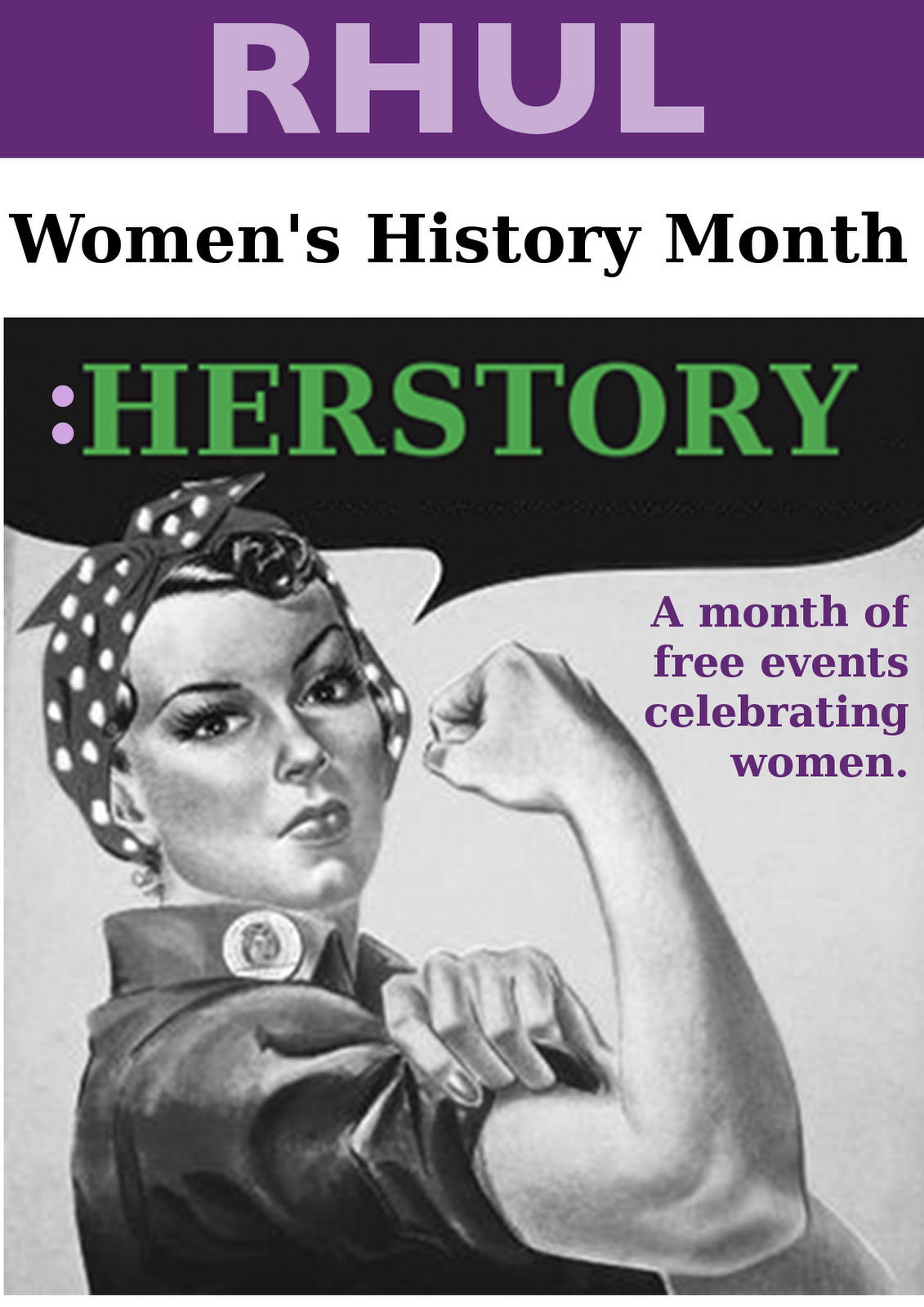
RHUL Women's History Month: HERSTORY
Wednesday, 29 February 2012
Poster Campaigns
For women's history month, as well as being involved in lots of events, we are running two poster campaigns across the RHUL campus. These are:
- What does feminism mean to you?
- Historical women.
We've found some preexisting work a bit like the first one at these links:
http://30.media.tumblr.com/tumblr_lzhrxnywQa1qde6ilo2_500.jpg
http://25.media.tumblr.com/tumblr_lzhrxnywQa1qde6ilo1_r1_500.jpg
For the latter, it will probably be a picture with a short description, and a direction to a page here, where we will post slightly longer articles, links to other resources for interested parties etc. If people are interested in further discussion, we can set up a forum for this.
Friday, 19 August 2011
Oh hello.
This is the blog of the Royal Holloway Feminism Society. Founded in 2011, the society aims to educate and campaign on a wide range of issues concerning feminism and gender, as well as honour Royal Holloway's history as a women-only college.
Wide-ranging cuts have also produced a national anti-cuts movement, and RHUL has its own anti-cuts women's group, the Royal Holloway Women Against Cuts Alliance, whose blog can be found here: http://rhwaca.blogspot.com/
If anyone has any submissions for the blog, feel free to email them to rhulfeminism@gmail.com
Jasmine, RHUL Feminism Society founder and president.
Wide-ranging cuts have also produced a national anti-cuts movement, and RHUL has its own anti-cuts women's group, the Royal Holloway Women Against Cuts Alliance, whose blog can be found here: http://rhwaca.blogspot.com/
If anyone has any submissions for the blog, feel free to email them to rhulfeminism@gmail.com
Jasmine, RHUL Feminism Society founder and president.
Subscribe to:
Posts (Atom)


.jpg)