This is the official blog of the Feminism Society of Royal Holloway University of London.To join our mailing list or submit an article, feel free to email rhulfeminism@gmail.com. To pay your society membership please visit www.su.rhul.ac.uk
Showing posts with label feminism. Show all posts

Monday, 6 October 2014


A Word on Catcalling 
Antonia King

Hey Freshers and returners! I remember that when I first came to university the cat calling and street harassment was a bit of a shock as I grew up in a very small town where it was less of a problem. So, I thought I'd do a little piece on street harassment in case anyone of you are in a similar position, or have just moved off campus and will have to deal with Egham hill a bit more often, or just want to read about about why cat calling sucks.

There are so many reasons cat calling is awful and there's also many people who will explain it better than me here, but I'll give if a go. Essentially cat calling is just reminding someone they're a sexual object. It's as if we should think, 'Oh, I was just going about my day to day life. I had forgotten for a second that my sexual appeal was the most important part of my existence, thank you for reminding me kind cat caller.' Not to mention that cat callers often reduce the object of their affection to body parts, boobs and bum being the most popular choices *rolls eyes*. To quote my most recent experience, one man decided to tell me that my 'ass' was so big he could see it from space. Now, no ones actually been to space to check for me, but I'm pretty sure he was exaggerating. All of this gives the same impression that magazines and tabloids do, that women are primarily there for the use of men and for sex objects. This is also part of the reason why boobs are used to sell everything from cars to groceries, but women are told breast feeding in public is disgusting, but thats a whole other thing. 

The major reason why I personally hate cat calling is because of how it makes me feel. It makes me feel like I've done something wrong. As much as I know I shouldn't blame myself, I do always end up thinking 'well this dress is short' or 'maybe the heels are giving the wrong impression'. It also makes me feel unsafe, particularly if I'm on my own. It's the reason I spend a lot of my money on taxi's and not walking at night instagramming pictures of at the moon (which I love to do). Cat calling makes me want to hide, and that is a problem. Trust me when I say that is their issue and problem, not yours! I like to say something back, for my own pride I guess. I'll often shout 'no scrubs' as I'm a massive TLC fan. Or I'll sometimes just run after a driver who beeped me shouting something like "I love you too!"- they look terrified. This being said, only do this if it is safe to do so, eg when you're with someone or in a busy location. Cat calling can sometimes lead to more dangerous behaviour such as following, which unfortunately I guess some of you are already aware of. So as much as you shouldn't have to moderate your behaviour because of harassment, do stay safe lovelys! There is no right way to respond, if you shout back then thats fine, and if you put your head down and walk fast away from the situation then thats fine too. 

*Serious bit coming up*. 

What is also important to note is that this is part of a wider problem. Unofortunately men are kind of taught they have an entitlement to women's bodies everywhere (that being said I have of course met some amazing gents who are more clued up on this than me). This isn't some complex radical feminist or misandrist argument, it's pretty basic stuff. Video games, language, the delightful Robin Thicke all help to make this stuff normal and all contribute to this feeling of entitlement. Even rom-coms do it (and I love my rom-coms). Guys are taught, even in romantic movies, that if she doesn't say yes, chase her or jump on her fayre ground ride (looking at you Gosling, my future husband)! When men are taught that "you know she wants it" and rape jokes are on main stream television shows, shouting at women on the street is seen as no biggy. Also, there's many reasons why most women don't talk about this more. For one, it's often seen as so normal that it doesn't need to be discussed. It happens so much, why even bring it up? It's nearly always treated as just a part of life. Also, alarmingly, if a women talks about cat calling experiences it can feel like bragging, cause all male attention is good right? Male attention is what girls are taught to want and compete for from a young age, with 'female' toys and games being based around makeup, beauty and 'getting the guy'. So why is this male attention bad? This is why you'll often hear the word compliment used in relation to cat calling. No! 'That's a nice dress' is a compliment, so is 'you look nice'. Commenting on body parts and shouting isn't a compliment, ever, it's just really creepy. So, if you do ever experience cat calling please know that you are entitled to feel however you want to about it. You may be told to stop 'humble bragging' when discussing it, or you may get told "well you do look fab tonight', but please know it isn't okay! Also, talk to any of the lovely SU support staff (Sid, the co-president for welfare and diversity is always here to help!), or of course fem-soc if you feel the need too. 

Sending love!
aj 
xx


Monday, 23 December 2013

Prez got cross about sexual harassment so she wrote about it.


Content warning: This poem contains strong language and discusses rape culture.
Rhyme for a Crime

Last Saturday I went out, out to a bar, 
The music was dodgy and floor sticky like tar,
But I was with two friends who are great and so, 
I was happy to be there and for drinks to flow.

We joined up to the big long queue, 
3 men were behind me, doing what men do,
Clapping each other on the back and the arm, 
Seemingly fine and doing no harm. 

Then low and behold, what did I find?

Some fucking cunt's hand on my behind!
Perhaps it was tired and needed a rest -
of all my features, my arse is known as the best.

But you know what, mate? That's not your call. 

It's for people in bed to compliment, not you to maul.
Because maul's what you did, you ham-fisted fuck, 
I flew round pretty quick and boy you all ducked. 

All 3 of you creeps laughing along,

You just didn't get that what you'd done was so wrong. 
The worst was I didn't know which of you it was out of the bunch,
So I decided not to guess my punch. 

I moved away, silently seething,

My heart kind of felt like it was bleeding.
This is why I fight so hard – because it's wrong and it's sick and it's twisted and gross, It's not a compliment - it's just fucked up, 

Don't you dare fucking tell me to stop making a fuss.

 My friends weren't too sure, 'it's not that bad'
I said 'if that happened to you on a bus you'd go mad.'

So this rhyme's little moral is, kids -

Just don't do it or laugh or shrug it away,
Consent is consent, and my body is mine. 
It's not a play-thing for anyone to abuse, that's not fine.

And it's moments like that which cause me to fight, 

Because it's men like that who don't know the meaning of 'No.' 
Those men are the ones who our society shapes,
The ones who refuse to stop, and will rape.

Rose Walker, 2013-14 President

Friday, 9 August 2013

2013/14 President Says Hello

Hey, everyone. I figured I should do a little 'Hello' spiel to any new faces and to anyone already involved who isn't familiar with me. I'm also going to tie in a little introduction to what the Feminism Society does and how it operates. Please note, anything I'm about to say does not necessarily represent the views of this society or any of its committee or members.

So. My name is Rose and I'm the 2013/14 FemSoc President.  I study English and Classical Studies here at Royal Holloway, and I'm about to re-take my second year. Things I like: cake (you'll learn more about that during any events that require refreshments) photography, peppermint tea, writing, positive attitudes to mental health and gender equality. I also like trying to make a difference in areas of society I feel are problematic (mainly the last two. I don't worry too much about the representation about cake. Although... http://rhul-fem-soc.blogspot.co.uk/2013/01/food-guilt-societys-tool-to-make-you.html)

So, it was a bit of a no-brainer when I started here to try and get involved with things I thought were important within our SU (that's Student's Union.) I won't go into the inner dealings of GMs (General Meetings) Sabbs (Sabbatical Officers) and heated debates by way of microphone, because I don't want to overload you.

I got involved in second year, because I was too busy thinking I was a super awesome fresher in my first. At the beginning of my second year, I soon realised there were quite a few like-minded people within our union, and I started learning about some really important issues that hadn't really crossed my mind - trans* people's representation, BME representation and LGBT issues. Getting involved with the Feminism Society made me realise that every minorities representation in society interlinks, and it's important for us all to realise that.

For a while, like anything new, I was a little nervous about turning up to FemSoc events as I went by myself, but I can honestly say that now there are at least 6 members who are close friends. And I mean the kind of friends you Skype, not the ones you wave at awkwardly in Crosslands every now and again. So, FemSoc is friendly, and really welcoming. There were loads of great social events last year - we went out for meals, for drinks, hosted Come Dine With FemSoc (that also turned into an impromptu birthday celebration for me) went to SU club nights together and travelled into London for events, amongst others. There was a huge variation, and that's something we're going to continue doing next year - if you don't like clubbing or you don't drink alcohol, totally not an issue. We try to make sure every event is accessible, both in terms of disability and also atmosphere.

As well as social events, most of our sessions are designed to get our members thinking about Feminism as a whole, and also individual issues and how Feminism looks at them. Last year we talked about politics, diets, body hair, sex, porn, mental health, the representation of BME women in the media, Islam and Feminism amongst plenty more. Some sessions the society invited speakers to visit us and lead them, and others we would set up ourselves and just chat about. We also linked up and put on joint sessions with other societies, including the Islamic Society, the Afro-Caribbean Society, the Debating Society and the LGBT society. Like I said before, we work hard at being intersectional.

As well as discussions / presentation events, the society has also worked on campaigns that directly affect our University and its members. It's proposed and passed many motions at GMs (sorry if I've lost you here. I'll post a crib-sheet on Student's Union language at some point to ensure everyone understands why Twitter goes berserk every few weeks) that support other student women. For example, the society wrote to and offered our support to students at a University which was being targeted and harassed by anti-abortion activists, and did the same to a university finding it difficult to set up their own Feminist Society. On campus, we've worked with Sabbatical Officers and Students Union staff to ensure our SU is a zero tolerance union - put simply, it and its staff have a zero tolerance approach to sexual harassment. Sexual harassment is a huge issue within society, and university campuses don't escape that. We've helped implement an atmosphere that means there are ways of dealing with and reducing the occurrences of these issues, and that students feel comfortable reporting anything.

I plan on writing another post within the next couple of weeks about why I think Feminism is still so important in our world today; there's way too much to include within this. I hope this has been an interesting overview about the society and the kind of things it does - if you have any other questions relating to the society, feel free to send me or any of the committee a message or post in our Facebook group. It would be great to see a lot of new faces in September - I hope this post has sufficiently piqued your interest.

Oodles of feminist love,

Rose Walker


Monday, 1 July 2013

#FEMLOVE

Susuana Antubam - Feminism Society President 12-13
Hey there, Its been a fantastic year at Femsoc and I would love to take this opportunity in my last post as president to thank all 40 members of the Royal Holloway Feminism Society for being so brilliant!

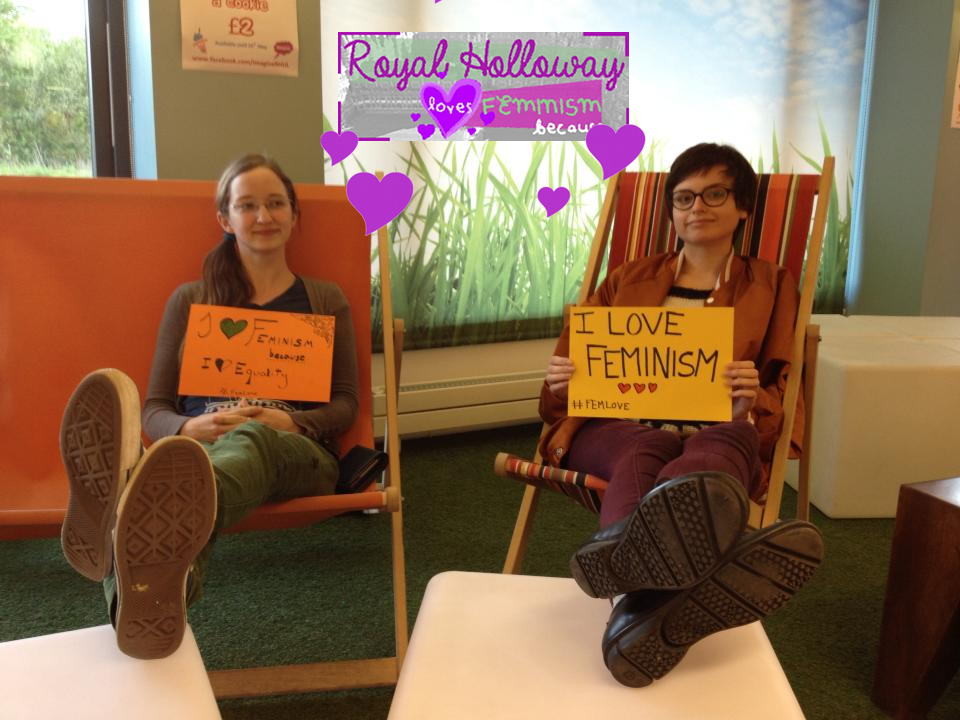
FemSoc Thursdays was the best part of my week for so long and hopefully it was an important part of yours. Check out our end of year photo project where we asked some of our members to tell us why they loved feminism. You can also check out these on facebook if you type in the tag #FemLove. Click on the images below for bigger versions :)


FemLove xx

Sunday, 3 February 2013

Check Your Feminist Label

By Sidonie Bertrand-Shelton,
SURHUL Equality & Liberation Officer

This post doesnʼt just apply to feminism, but to any label you define yourself with. This post is for those of us who have worn a label for so long, we almost ignore it, and feminism is my example.

Wearing a label for a long time, such as ʻfeministʼ or ʻfeminist allyʼ, we sometimes forget to challenge ourselves and the stories we hear. We forget to assess our language and our actions. We think ourselves untouchable, and we forget to question that too.

This is dangerous because it can close off the open minded from investigating the opinions we hold. When you were curious about feminism, when you were confused yet enthralled by the sheer majority of opinions and debates to be had, who did you turn to?

Amongst others, you turned to feminists. We turn to the people who define themselves by the label we are so curious of. This is normal, of course we would ask a self proclaimed expert! The danger lies in the assumption that we, as the expert and proud owners of this label, know it all. This experience can also be alienating for those labelled as feminists and who actively analyse the world around them, while the “experts” no longer question the world or their actions.

If weʼre supposed to be leading a movement or a new wave of thinking, how can we expect others to listen to our challenging ideas when we cannot challenge our own? We should question ourselves and each other more often. We should look at our actions, not only in our political lives but our work lives, our private lives and our relationships. Attitude shapes behaviour, and it should be an attitude worth being shaped by.

Nobody is perfect and we all slip up, but the important thing is to listen and to learn. We need to learn from every mistake, whether it be personal or political. We need to work hard to remain open-minded enough to listen at the time of criticism, which isnʼt easy. We are university students: we complete our education by ticking the right boxes and making the right choices - but we are also taught to analyse and question, to come up with our own ideas and to assess. So apply this analysis to yourself and your labels.

Stop. Assess. Question. Be curious. Dwell. Listen. Think, and question again.


Monday, 31 December 2012

RhulFemSoc's Women of the Year 2012

It has been a year and a day since Rhul Fem Soc first published our first ever blog post, and what a year it has been! Since then we've had just over 80 blog posts and over 25,000 hits which is amazing and we've decided to mark the end of this year by naming our favourite Women of 2012.

January - Emma Stone
As a result of being hilarious and awesome, Emma Stone received awards for being Favourite Movie Actress and Favourite Comedic Movie Actress during the People's Choice Awards earlier this year.  However, being a talented actress is not just what Stone is about.  She has highlighted a number of sexist issues in regards to how actors are treated differently by the media purely on the basis of their gender.  She pointed out that men get asked interesting questions whereas she and other females in the business are constantly questioned about style and what item they can't leave the house without. Yawn!

February - Sandra Fluke
Sandra Fluke is a law student from Georgetown who stood up in front of the Congressional Committee and requested that birth control, which is hugely expensive and can force women into financial crisis, be given out for free by her University even though it essentially went against the University's Catholic beliefs. With the financial burden it places on students, she highlighted that this could lead to its lack of use.  Her requests were met with a lot of opposition including a foul response from Rush Limbaugh who accused Fluke of being a slut and declared that her request for free contraception meant that tax payers would be paying her to have sex thus, making her a prostitute.  Fluke remained strong in this and refused to back down.  Limbaugh eventually apologised and Fluke was named Time's Person of the Year.

March - Hana Shalabi
Hana Shalabi was a Palestinian woman arrested and detained in Israel without charge. In protest she began a hunger strike, which ended in March after 43 days. She has now been released and ‘exiled’ to Gaza but is unable to return to her home in Jenin, North Palestine. Whilst enduring the extreme physical and psychological impact of the strike, she also brought the issue of Palestinian justice to the international platform. Her strike brought attention to the frequent use of detention without charge by Israel, and the injustices of the occupation more generally.

April - Michelle Bachelet
In a statement made to the 12th International Association of Women in Development Forum on Women's Rights and Developments, Michelle Bachelet highlighted the extent of economical development that women need in order to gain equality.  She spoke of the ongoing need to overcome gender-stereotypes, sexism and patriarchal power structures.  She is not just an amazing woman of 2012 however, she was the first female President of Chile and was in power from 2006 until 2010.  She focused on increasing social benefits in order to weaken the inequalities between the rich and the poor as well as focusing on women's rights.  In 2010, she became the head of United Nations Entity for Gender Equality and the Empowerment of Women (UN Women).

May - Jessica Ennis
In May 2012 this incredible heptathelete won gold this summer at the 2012 London Olympics; but in May, she was criticised for being fat by UK Athletics. FAT. Did you hear anyone criticise the male athletes? No, you didn't. She hit back with: “Everyone has their hang-ups, but I see my body as a training tool and I feel good about it.” ...then she won gold. While most of us might not have a body like hers, good on her for standing up for common sense and the importance of your own feelings on your body - nobody else's opinion matters.

June - Anita Sarkeesian
In June this year, feminist media critic and founder of the online feminist video Feminist Frequency, Anita Sarkeesian, launched and advertised her research project which looks at sexism in the gaming industry. Ironically she received lots of cyber abuse from misogynistic gamers which she dealt with and used as a platform to highlight the issue of sexism in game culture beyond a national level.

July - Julia Bluhm
When I was 14, I was too trapped in my own angst and love triangles to be particularly aware of the world around me. Whilst I was no doubt affected by unrealistic portrayals of women by the media, it would be years before the feminist in me was developed enough to be aware of the problem, or that something needed to be done about it. Julia Bluhm, however, had an awful lot more wherewithal, and used it to lead a successful campaign (including an 86,000 signature petition) resulting in Seventeen magazine promising to include photographs only of genuine women of a healthy weight. Not bad for 14!

August - Gabby Douglas
At the age of 16 this amazing young woman broke records becoming the first female gymnast of colour and to win gold in individual all-around champion in Olympic history, and the first American gymnast to win gold in both the individual all-around and team competitions at the same Olympics. Although the media wanted to highlight her hair rather than her talent at times she stood up and defend herself and her hard work. She should be very proud of herself. She turned 17 today so Happy Birthday Gabby!

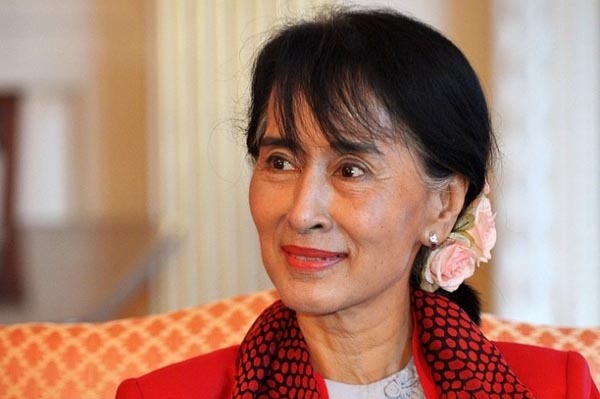
September - Aung San Suu Kyi
For her remarkable work in fighting as a campaigner for Democracy in Burma, Aung San Suu Kyi was awarded the Congressional Medal of Honour.  After a 15 year struggle under house arrest, in which she was often subjected to solitary confinement and forbidden to see her two sons and her husband, she was finally released and awarded for her peaceful fight against the militaristic rule of Burma.  Aung San Suu Kyi is therefore an amazing woman of 2012, her struggle and bravery make her a prominent figure in the world today.

October - Malala Yousafzai
On October the 9th Taliban gunmen stormed onto a bus occupied by school children with the intention of killing eleven year old Malala Yousafzai.  She was shot in the head and neck but survived. The Taliban have made it clear that they are against the aspirations of the brave Yousafzai who, at the age of nine, spoke out declaring her love of education and her aspirations to become a Doctor.  Her struggle for the right of education has made her a prominent child activist and in 2011, she was nominated for the International Children's Peace Prize and was then awarded Pakistan's first National Youth Peace Prize.


November - Jennifer Lawrence
Actress Jennifer Lawrence recently spoke out about Hollywood body ideals and the fact that "In Hollywood (she's) a Fat Actress" and stated that she was asked to lose weight for the Hunger Games and refused saying that she "never wanted a little girl to say, 'I want to look like Katniss. I'm going to skip dinner.'" She's working to create a new industry standard despite criticism potentially damaging her career and we think that's awesome.

December - Sonali Mukherjee 
27-year-old Sonali Mukherjee, who was blinded and disfigured by an acid attack aged 18 after turning down a marriage proposal, won 2.5 million rupees on the Indian show "Kaun Banega Crorepati". She will use the money she won to pay for treatment. Her attackers were sentenced to 9 years but later released on bail. She said: "It's very easy for victims of acid attacks to swallow poison but I made the choice to stand up and scream and shout against the violence".


Happy New Year!!

Love Rhul FemSoc
#femlove

Saturday, 29 December 2012

It's The Twitter Youth Feminist Army! Yes, you heard right.

You know we at Fem Soc love Twitter so we were super happy to discover this bunch! At the last Student Feminist Coordinating Meeting we were lucky enough to meet two of the youngest feminists to show up! Secondary school feminists ftw! Anyway, they told us about The Twitter Youth Feminist Army, a network of young people who met through Twitter who support each other in their journey to feminism. The TYFA has many members (and will hopefully have many more in the future) who have interests in all areas of feminism.  They have different political and religious views and currently range in age from 12-28 and have members all over Great Britain! It was lovely to meet the next generation of feminist activists. One of the founding members, 15-year-old Lili Evans, was nice enough to give us an interview and here it is! :) 

How did the Twitter Youth Feminist Army come about?
TYFA: Once upon a time, on October 18th, 2012, Emily, Isabel and I were having a conversation about how our fellow feminists on twitter and ourselves were like an army, taking down the patriarchy, one tweet at a time, when the name, Twitter Youth Feminist Army was mentioned by Emily. We all immediately got excited and I hashtag-ed it and that is how the Twitter Youth Feminist Army was born!
To me it is a life-line which connects me to like-minded people, who share my views and values. It is an intersectional feminist group who are inclusive to all, regardless of age, religion or ethnicity. It is a place to learn and to teach, to share and to experience. Most importantly, the TYFA shows people that feminism is far from dead and shows a different type of feminist that is so often stereotyped. I think I may currently be the second youngest member of the Twitter Youth Feminist Army and I have found each and every person I know I will be an active and supportive member for many years to come!
Although this is all true, we are still developing and finding our feet. This means for instance that we are hoping to create a committee to be in charge (at the moment I am doing most of the organisation and Cat is very good at doing the Facebook group stuff) and start doing projects to help our members discuss and find out more about different areas of feminism. We have Marxist feminists, body-positive feminists, radical feminists and many other types of feminists in our group and it would be amazing to learn from each other.
How many are there of you?
TYFA: We are obviously always recruiting but at the last count we had 25-30 registered members (which basically means I know who you are and have your email).
When we get asked to do a piece of writing by the Twitter Youth Feminist Army, we call it a project and there were 11 members on the last project. It's a great way to get to know everyone better!
When did you start calling your self a feminist and why?
TYFA: I think it all started when I decided that I wanted to become more involved or at least knowledgeable about politics. This was when I had just turned 14 and the Arab Spring was starting to get more coverage on the news. I saw the appalling way women were being treated by the men and their governments in other countries and it made me think about my own. This made me interested in women’s rights and the patriarchy.
Another thing that introduced me to feminism is an online magazine called Rookie, first shown to me by my best friend and fellow feminist Jess. Rookie is a magazine written for girls by girls, although it does not often expressly use the word “feminist” to describe itself; many of the readers – and subsequently writers - identify as feminists. There are articles on everything from ice cream reviews to dress up ideas and many articles have feminist undertones although not expressly “feminist issues”. This made me interested in body positivity and being myself.
Have you witnessed a lot of incidents of sexism at school?
TYFA: I go to a girl’s school so there is not much chance for sexist comparisons (not being as good as a boy at something because you are a girl etc) and we are treated equally because there are no boys to prefer. Of course there is still aggressive gender-stereotyping, both by the teachers and from our peers, and I think there might be slightly more than at some of my friend's mixed schools.
There have been numerous occasions when teachers have assumed that we all love shopping or are interested in fashion. This sounds so trivial but when it has been beaten into you that you HAVE to love clothes or babies or that you must want a family when you are older otherwise you are weird and unnatural it really makes you feel awful about yourself, like you are not good enough.
Do you talk to other pupils at school about feminism?

TYFA: Occasionally I talk to others but hardly ever using the name “feminism” as it tends just to make people dismiss what I say and go “feminists are just hairy old women who won’t let the past go”. Most people I talk to think that most battles feminists fight are supposedly over, most don’t necessarily make the link between feminism and sexism which I think is strange and needs to be changed (that rhymes!). Most of the times that I do discuss or debate feminism and its issues with peers it tends to be brought up in a lesson and I generally don’t feel comfortable as it usually ends up with me being very upset and frustrated over other people's dismissal of the subject.

Considering it is so difficult meeting people at school who call themselves feminists, what do you think would be the best way to make people aware of deep-rooted gender stereotypes that are so ingrained in our society?
TYFA: Just to talk about it. It doesn't have to be called feminism. Once you get people talking about it, thinking and noticing the issue becomes more and more.
How do you think older feminist can help TYFA?
TYFA: TEACHING TEACHING TEACHING! Although we do have more experienced feminists in our group, many of us have been feminists for a year or less. Even for those who have been feminists longer, it is always amazing to learn new things. The main way other feminists can help us is teaching us without being patronising and understanding it can sometimes be a bit scary!
What have you found inspiring about feminism and how do you think the feminist movement can inspire others?
TYFA: The strength of women to never give up even after years, DECADES of stereotyping, ignorance and belittling.
Have the TYFA got any upcoming plans?
TYFA: We are still new and developing but one of our immediate plans is to make a central committee to help organise new members and try to raise our profile and help to reach out to other women and girls who need support in their journey to feminism who are experiencing the sexism ingrained into our patriarchal society. 
We recently got a new logo which was designed by one of our members, Niz. We also set up a Facebook page, on which you can see our new logo!  One of the things we are trying to organise is a monthly newsletter, updating our members on some things that other members are doing, various campaigns or marches happening.

Want More?
Follow the feminism with #tyfa #TwitterYouthFeministArmy 
Become a member by emailing: twitteryouthfeministarmy@live.co.uk
Like the Twitter Youth Feminist Army on Facebook! 
For more articles from Lili Evans, find her awesomeness here


Disclaimer : TYFA are not associated to the company Twitter and are not competition for them.

Monday, 15 October 2012

New to Feminism? Watch this!

Some newbies to feminism and to Rhul Fem Soc this year have been asking the usual and valid questions about feminism and what being a feminist means. It can be hard defining yourself or "coming out" as a feminist when there are so many misleading representations in the media about feminism and feminists. So anyway! Here is Elena (aka Monday Girl from Insanity Radio) responding to a woman who made a anti-feminism youtube video and sharing her thoughts on being a feminist.

Sunday, 7 October 2012

A Wild Welcome Back at Royal Holloway :)


We kicked it off with the SURHUL Welcome Week Societies fayre, where 146 students signed up to our email list and copies of The Wilding were available for free. It was so nice to meet you all and tell you about the society. We are also looking for new articles and donations for Issue 2 of The Wilding.

Hopefully all of you who have signed up have started getting emails from us. If not, don't worry because Josie (pictured on the left) will add you to the email list if you email us at rhulfeminism@gmail.com.
Remember that you can become a fem soc member online by going to the SU website  >  Log in/Register - (Your username is the number on your college card starting with 100******) > Click on the activities link > Click on the societies link and you will find (Feminism) > Join by adding the £7 to basket > Scroll down to 'Review Basket' at the bottom of the page > If you haven't already, you will also have to add the Students Activities Membership (allows you to join clubs/societies) which costs a further £10 > Proceed to check out and BOOM!


Then there was the First SURHUL General Meeting of the year where some fem soc members ran for various positions in the student union. It's great to know that we still have such passionate feminist activist around and wonderful to hear them mention Fem Soc in their speeches. Congratulations to Jack Saffery-Rowe on being elected to the SHRHUL Campaigns committee and to Jessica Goldsmith on her position as Gender Equality representative on the Inclusion and Representation senate. The SURHUL Inclusion and Representation senate has a mission to ensure accessibility, inclusion, representation and awareness are prominent at SURHUL. The I&R senate is chaired by Sidonie Bertrand-Shelton, and other places on the senate that still need to be filled are the: Disability Rep, BME (Black and Minority Ethnicity) Rep, Student Parent and Carer Rep and Halls Reps. If you are interested in running contact Sid or come to the next General meeting.


We had our introduction meeting on Thursday and got to engage with lots of new members. Next week we are teaming up with  Rhul Philosophy society and presenting "Victorian Secrets", a discussion on Victorian gender ideology and the development of gender philosophy. If you have facebook please click attending on the event page so we have a better idea of numbers. On the night, along with many other things, we will be discussing:
- What effects did the Victorian era have on gender roles?
- Royal Holloway's women in the Victorian Era
 - What the heck is gender anyway?
- The birth of Gender Philosophy
- Gender in other cultures
- Gender myths
This is our first collaboration of the year and it will be on October 11th, in Arts Building Lecture theatre 2 at 6pm. Hope to see you there.


Also next week Sunday is the Feminist Students' Coordinating meeting at the Feminist Library in London. 


FemLove 
 

Monday, 24 September 2012

SlutWalk 2012 – or Why I don’t really care about the controversy

April Howard discusses the merits of SlutWalk

SlutWalk - we’ve all heard about it. What do we all think? Despite attempting to ignite activism and achieve real social change, the scantily-clad marches through cities and towns all across the world have truly polarised opinion within feminist movements and the general public alike.

Why are they using the word slut? 

Who do they think they are? 

How can they use their bodies like that to raise the cause of feminism? 

I have encountered all these reservations in feminist circles and amongst other acquaintances and friends.


Who cares? This is the thought that usually comes into my head at such discussions, often unbidden
and usually unspoken. Yes, I have a persistent inner-debate over using the word slut, but really, SlutWalk’s association of everyone in society with that word isn’t such a bad idea – it instantly lays open the ridiculousness of using the word slut to denigrate and allow a “certain type” to be raped without protection and without certain resource to justice.

With the SlutWalk organisers yelling the abysmal figures of 7 in 100 reported rapes ending in a conviction in the direction of the CPS and police, surely any action that brings attention to such a clear weakness and blind-spot in our judicial system is worthy of support?

Yes, some of the photographers may have come to get a picture of scantily-clad women, but it got
photographers to the event and interviews in many local and national newspapers. The view of thousands of men and women in unusual outfits, shouting slogans that described the need to blame the rapist and not to victim (“It’s a dress, not a yes” and “Whatever we wear, wherever we go, yes means yes and no means no” being amongst my favourites) caused many people in London, and across the world’s SlutWalking cities to stop and consider an issue that has long been swept under the legal and social carpet.

Academic feminism has an incredibly important place in influencing governmental policy, but movements such as SlutWalk can access all levels of society and cause a stir on the streets. If society and those holding judicial power within society continue to tell men that someone’s drinking or attire can excuse rape on the grounds that the victim had somehow “asked for it” or been a “vulnerable position”, then people will continue to view rape as something that only happens in certain settings, to certain people. By loudly calling bullsh*t on this analogy and demonstrating that rape is never acceptable, SlutWalk use their attire and slogans to visibly demonstrate the absurdity of slut-shaming and victim-blaming.

So, I went to my first SlutWalk dressed in a 60s dress with suspenders underneath to highlight that neither attire legitimises rape.

Did I enjoy the walk? Yes, I did.
I feel empowered to stand up to the rape-culture we live in? Yes. 
Did I feel empowered to call bullsh*t before I Slut-walked? No.

SlutWalk may not be your cup of tea, yet I defy anyone to refute the good it has done – uniting millions of people across the world to publicly reject rape-culture and sparking millions of discussions on the acceptability of rape-apologists. I refuse to believe that because of a word and a bra these global outpourings of frustration are an endangering addition to the feminist cause.

Also we managed to get on to Sky News briefly and April's placard is featured in The Huffington Post.

Thursday, 21 June 2012

Stop the Arrests Campaign Launch: Report

On 18 June 2012, members of RHUL Fem Soc went to the Stop the Arrests Campaign Launch in London.

Stop the Arrests is a campaign group calling for a moratorium on the arrest of sex workers during the London 2012 Olympic Games. They are concerned that the policing of sex work and establishments associated with the Olympics will compromise the safety and autonomy of workers in the industry. Stop the Arrests hopes to build working alliances with groups campaigning for the rights of women, sex workers and migrants. Through this campaign, they hope to force the political issue, which cuts broadly across mainstream parties, a mixed bag of opinions in each. I’m stressing the particularity of the aim, as I feel this was highlighted quite late in the evening’s proceedings, and the breadth of topics which were and were not discussed make more sense when this is highlighted first.


The chair began the evening by giving an introduction to the group x:talk, who initiated the letter to the Major of London regarding policing of sex workers and sex establishments in the lead up to the Olympics under the Stop the Arrests Campaign. X:talk is a grass roots organisation, a sex worker-led workers co-operative whose main activity is the organisation of language classes for sex workers. This isn’t something which was concentrated on at the campaign launch, but you can find more information about x:talk on their website. To whet your appetite, here’s one of my favourite sentences from the “about” page: ‘We understand language to be a politically and socially charged instrument of power, which we aim to teach critically and thoughtfully according to the specificity of our classes.’

To move back to what was actually said, x:talk have been in dialogue with groups worldwide regarding the London 2012 Olympics, especially concerning the policing tactics which may be brought in surrounding them under anti-trafficking auspices. They highlight the ineffectiveness of these tactics imposed from above, believing that sex workers are best placed to deal with problems which concern them. They call for campaigns to target laws effecting sex workers, relating to third parties, and to the pursuance of premises. Some of the variety of groups with whom they work are represented in the speakers.

The first speaker was Dr Laura Agustín, trafficking expert and author of Sex at the Margins: Migration, Labour Markets and the Rescue Industry. Laura described the hysteria over a rise of trafficking associated with large sporting events. She identified this rise in trafficking as a zeitgeist, and, moreover, one which has been disproved (see, for instance, research relating to the Germany 2006 World Cup and the South Africa 2010 World Cup, discussed on the Stop the Arrests website on “The Evidence” page). Furthermore, Laura stated, there is no contradictory research evidencing a positive link between large scale sporting events and increases in trafficking.


It seems, then, that political hysteria over trafficking associated with large sporting events must result from concerns apart from those stated, concerns such as immigration more widely. The vocabulary employed is frequently a step backward, with women construed as passive victims. There is also the idea of the “rescue”, in which raids of premises are reported to have resulted in, for instance, 3 people being “arrested” and 23 “detained”. What does “detained” mean? It has been difficult to find out through freedom of information claims. It seems that those detained are told that they should leave the country, resulting in yet more clandestinity. Laura concluded by reminding us that ‘selling sex in this country is not a crime’ - it is only activities surrounding the selling of sex, such as soliciting and the running of brothels, that are against the law.

Next, Vera Rodriguez, who is involved with x:talk and the English Collective of Prostitutes played us some interviews with voices from the industry. We heard two interviews.

First was the voice of a Brazilian woman who ran a flat who was told by the police that they would arrest her daughter, should she not plead guilty to trafficking. Having pleaded guilty, the judge of her case acknowledged that she had treated women in her flat well, but still gave her a custodial sentence due to what he considered to be the immorality of her actions. She spent nearly three years in prison, separated from her children, one of whom was only six years old. Having lost her home and possesions, friends who attempted to assist her were arrested and threatened with deportation.

Second was the voice of Jenny, the mother of a severely disabled daughter. As such, sex work was a job in which Jenny could control when she worked, in order to meet her bills, costs of equipment for the home and so on, when benefits are meagre. She said that restrictions and harassment due to existing laws on sex work made the job dangerous. Under proposed changes, she would risk a criminal record if seen working more than twice in three months by the police. Jenny described how the criminalisation of sex workers could result in a vicious circle: if she got a criminal record for soliciting, this would likely become the only job she could do. She also highlighted the cost the government would incur if she put her daughter into care.

The next speaker was Georgina Perry, manager of Open Doors, a free and confidential sexual health service for people working in the sex industry located at Homerton University Hospital in Hackney. The areas for which they work include three of the six Olympic host boroughs. Over her talk, Georgina aimed to outline why services (such as the NHS, in schemes such as Open Doors) should work within a harm reduction framework.

Georgina began by considering why it is that people feel drawn to a vocation in health. She sees it largely as relating to health as a universal human right. However, services are frequently guilty of discrimination and are judgmental towards those who do not conform to imposed norms (for instance, intravenous drug users). It is groups like this who schemes like Open Doors engage with.


 Georgina identifies three main groups with whom Open Doors has engaged. These are: 
  1. Migrant sex workers – normally about 1000 per year (although, despite the public belief that the Olympics will lead to an increase in migrant sex workers in London, she notes that this year they have actually seen a decrease in attendances)
  2. Street sex workers – frequently individuals who also encounter judgmental attitudes due to addictions etc;
  3. Survival sex workers – do sex work to make ends meet (e.g. like Jenny, to pay bills). Open Doors have met increasingly more survival sex workers over the last three years.

Georgina described the difficulty of navigating the NHS system, especially for migrants, who may not have a comparable public health system in the country from which they migrated. People may find themselves, referred from department to department before receiving treatments. In some cases, for instance which a person is seeking a termination, this can result in it being two late by the time treatment is offered to them. Services like Open Doors help these people to navigate the system, and help the NHS and other services by highlighting aspects which don’t work well. In particular, they can assist with navigating the interdependency of health and other services such as housing.  Georgina summed up the approach by describing it as client and right based, rather than as a “rescue”.

Georgina went on to outline what Open Doors have started seeing in the run up to the London 2012 Olympics. From 2008, Georgina has been attending meetings about the Olympics, for instance at the GLA. The Olympics are seen as a great opportunity for causes to attract money and attention to their message, and we see with trafficking. Counter to the claims used in promoting this rescue agenda, women in the sex industry who Open Doors have worked with rarely do not know what they are doing or why they are doing it. However, despite the statistics held by Open Doors (the NHS is good at counting!), their points are ignored.

Government cuts have affected who takes the lead in these meetings, with some groups disappearing. Open Doors have seen a large increase in brothel closures in East London, 2009-10, when a new police unit was introduced for this task. The first of the voices from the industry which we heard earlier was one woman effected by this move.

The knock on effects of this increased policing are dangerous. It has become more difficult for services such as Open Doors to build relationships with sex workers. Open Doors do not work with the police, but when one has such negative experiences with one public service (Georgina mentioned particularly police response to a case in Barking and Dagenham, which shall be returned to later), it is more difficult to trust another. For instance, more workers now do not inform Open Doors when they move home. Sex workers are also experiencing higher levels of violence and aggressions, with more attacks on flats taking place, for instance. Again, the Barking and Dagenham case serves as an example.

Next we watched a video link-up from Dr Brooke Magnanti, aka Belle de Jour and author of The Sex Myth. Brooke highlighted that police targeting of consensual sex work under auspices of anti-trafficking campaigns created an environment where a concern for personal safety (e.g. in not being clandestine, in working with a group in a flat) could result in arrest. This leaves sex workers with a decision to make between a criminal record and their own safety. Brooke also mentioned the one-sided reporting of sex work in the media, and the ineffectiveness of prohibition. As she writes on one of her blogs (the 18 June 2012 entry): It's time we started acting like grownups and stopped pretending that making something illegal makes it cease to exist.”


Following the end of the official speakers, Carrie Mitchell, from the ECP, offered to read us a statement from Lana, a sex worker targeted in the Bradford and Dagenham case already mentioned. As a quick background, quoting from here:
Last December in Barking & Dagenham a violent gang carried out a series of robberies on brothels at knife point. Sex workers were deterred from pursuing the attacks after police threatened them with prosecution. Thus many more were attacked and one woman was raped. Once the police agreed to an amnesty from arrest, sex workers were able to come forward.

Lana worked in a flat near an Olympic site. The flat was well established, and they had good relationships with neighbours. In this series of violent attacks, they were robbed, and sent a tape of the events to the police, who did not respond. They were targeted a second time, which they did not report. Then a third time, when sex workers were assaulted at knife point. This they reported, and police turned up to investigate the same night. However, a couple of days later, they received a letter from the police, indicated that they were liable themselves to be prosecuted. They sought to talk to politicians, and were in contact with the Guardian, who published this article. The police responded to questions, claiming that the sex workers were unwilling to cooperate, and attributing the violence they suffered to their ‘dysfunctional lifestyle’. Lana responds. The police were persecuting rather than protecting; that’s dysfunctional. The gang attacked once more. Another flat posted a video on Youtube, in which attackers were recognised. The ECP helped facilitate contact between the Barking and Dagenham police, and those in Lewisham, who had dealt with a similar case previously, and charges have now been brought against gang members. However, even with the support which she has received, Lana said that, thanks to her experiences, she would not report again.

The last amnesty on the arrests of sex workers followed the Ipswich murders of 2006. This was not formally stated, but resources for sex workers were made available, and no arrests were made for a year. A dedicated phone line was established for sex workers to report violence  in anonymity and confidentiality. However, this was cut off the day after Steve Wright was arrested.

Next, the floor was opened for questions.

An audience member highlighted the difference in statistics employed by groups campaigning for legalisation, amnesties, and anti-sex work groups. They asked how these arose, how do we know who to trust?
Laura Agustín outlined the impossibility of accurate statistics in this area. Noone can know how many undocumented migrants and unregistered people there area; groups rely upon estimates. Not all businesses are run legally, resulting in more of the same problem regarding statistics. Furthermore, if a researcher calls a receptionist, for instance, posing as a client, with a request to see a sex worker of a specific nationality, they are likely to receive a response that this is possible.
An audience member from the ECP criticised anti-sex work campaigns for many of the same reasons, but also highlighted responses to the Pentameter from different groups (see here).
Laura added that there are disagreements between parties over what ‘trafficking’ means, and that this should be bore in mind when considering reports.

The second question concerned attitudes of local MPs and media in Olympic boroughs.
Georgina Perry took the lead in answering this question. She highlighted that the media won’t report boring (non-)stories e.g. ‘People are selling sex and using the money they earn to study’. Commissioned reports may also feel pressure to make exciting conclusions.
Local MPs are interested in votes. Having an opinion on who a sex worker is, what they want, etc can provide a universalism to use as a vote spinner. Georgina mentioned the example of Tower Hamlets, where campaigns against dancing clubs also expose the effect of cultural pressures and concerns.

The third question asked if the campaign had received any communication from the Met or the Major of London.
The chair explained that the letter to Boris Johnson had been presented a couple of weeks ago, but had received no response as of yet. The Metropolitan Police have been in contact, informing that they know of the campaign. They are launching a ‘rescue’ campaign with a religious organisation in the Kings Cross area, a move which has been organised without the consultation of sex workers. The protocol to be employed by the police regarding sex workers during the Olympics was due to be announced today (18 June), but has not been.
Here, Laura Agustín added to discussion of the ‘rescue industry’, as this had come up a few times in the evening. The description of the ‘rescue industry’, as in her book title, and used this evening, is not to say that those who are ‘rescued’ have any less authentic experiences: it is not to say that victimisation etc does not ever occur. However, for the Met to employ only this type of organisation for consultation is shocking.

A final question asked if the campaign had considered mounting an aggressive defence of sex work.
Laura Agustín outlined that this is a very focused campaign, but many who are involved are also involved in defences of sex work elsewhere.
An audience member outlined the Swedish model of sex work, where in law it is presented as violence. Abolitionist viewpoints such as this push sex work further underground, with a criminal client and a victim worker, and do not solve problems.

You can sign an open letter to Boris Johnson here.

There will be an organising meeting at Centre for Possible Studies, 21 Gloucester Place, London W1U 8HR next Monday evening (25 June 2012).