This is the official blog of the Feminism Society of Royal Holloway University of London.To join our mailing list or submit an article, feel free to email rhulfeminism@gmail.com. To pay your society membership please visit www.su.rhul.ac.uk
Showing posts with label film. Show all posts

Tuesday, 26 November 2013

Visit from Chloe Trayner (Underwire Film Festival)


Last Thursday, the lovely Chloe Trayner (producer of the ‘Underwire Film Festival’) came to talk to us at RHUL about the London based film festival; she brought along a fantastic showcase of last years films to give us a taste of what to expect, as well as answering our questions.

‘Underwire’ is a festival celebrating and discussing short films made by up and coming female film makers; as well as various screenings, the week long event (19th-23rd) included panel discussions on women's representation in film. 

The festival is run almost entirely by women, after being founded in 2010 by Gabriella Apicella and Gemma Mitchell, it focuses on the fact that women still make up a small minority of film creatives and aims to help create a ‘more balanced industry’. Short films are nominated for female director, screenwriter, cinematographer and editor awards and entries compete to win career based prizes - membership to organisations like ‘Directors UK’ or editorial suite time and training. 

Chloe’s showcase of films demonstrated the huge variety of films they screen, everything from music videos to a dramatic experimental piece called ‘Stormhouse’ in which the actors never spoke. It was really refreshing that the festival is so inclusive, it seemed to give women a huge amount of creative space and the chance to experiment with their ideas and create any type of film they desire. This resulted in some striking pieces, a lot of which focused on feminist or feminine issues or points; pregnancy, women’s career choices, prejudice both against genders and nationalities. The topics stayed with us after hearing Chloe talk, a good demonstration of how the festival is achieving its aims by giving women creative space at the same time as spreading ideas and prompting discussion on significant topics. 

On top of the captivating nature of the films, it was massively inspirational to  talk to a woman like Chloe who has done so much with her career by such a young age. Her success is extremely encouraging especially to students studying film and media but also generally to women with strong career aspirations, reminding us all that if we push ourselves hard enough we can achieve a huge amount. 

Overall, it’s fantastic to see events and organisations in creative industries to begin to tackle the issue of gender bias in media representation of women and supporting people with by giving them a good starting point in their career. Hopefully this mentality and motivation will emerge in other industries.


- Natasha (Communications Officer)


Image at top of page: a poster in grey and pink, advertising the event described in this blog post, with a picture of Kathryn Bigelow behind a camera. 

Tuesday, 12 June 2012

Feminist Icon: Laura Mulvey

by Susuana Antubam

Yesterday, in Royal Holloway’s prestigious Founders Building, I had pleasure of listening to a lecture given by the great feminist film theorist Laura Mulvey. Having overheard that she hadn’t visited Royal Holloway in over ten years, I became even more overwhelmed by her presence and the great number of admirable academics in the room sharing this experience. I'm  one of the many film/media students that have quoted her master piece of an essay Visual Pleasure in Narrative cinema (1975) where she writes about the dominating male gaze and objectification of women in classical narrative cinema.

 In her hour-long lecture, which was titled: Love and Death in three films by Max Ophuls: Liebelei (Germany 1932), Letter from an Unknown Woman (US 1948) and Madame de… (France 1953), I was able to witness her fascinating outlook on gender and sexual politics in film. She explored questions of masculinity, patriarchal disruption and the reoccurring presence of the love triangle between the aristocratic husband, wife and womaniser in Ophuls’ films. I was lucky enough to able talk to her after the event for a quite a while. We discussed my dissertation as it revolves around the female representation on film, this was literally a mind-blowing experience since I have already planned to include some of her work. Not that I don’t equally adore and respect my awesome feminist dissertation tutor who is also a friend of Mulvey’s haha. 

We also spoke about the Feminism Society and must-see feminist films and feminist activism. One of the most interesting things she talked about is how she got into feminist film criticism, saying that in the 60s she very much enjoyed cinema, however after being involved in the feminist scene she then began to look at cinema with a critical eye which partly spoilt the please she gained from it. However she then stated that she found a new please feminist film criticism.

This journey into feminist film criticism is one I recognise. I also found that we shared common ground when it came to software, during the lecture when the computer wasn’t being agreeable, she stated that she wasn’t incompetent; she was just a Mac person. 


It was a lovely event and I’d like to thank the organisers for such a great evening and hope that it wont be another ten or so years before Laura Mulvey returns to Royal Holloway.

Sunday, 29 January 2012

Women in Film: The Manic Pixie Dream Girl and 500 days of Summer

By Susuana Antubam

The damsel in distress, the subtle dominatrix or femme fatale are female stock characters that have been repeated endlessly throughout film history. The British feminist film theorist Laura Mulvey, wrote that in patriarchal society ‘pleasure in looking has been split between active/male and passive/female'. Look at Laura Mulvey's work by the way – she's awesome.

In a male lead film, women are usually presented as accessories, while in a female lead film, a lot of the time the women appears to be really lacking a man in her life. This isn’t always the case for all movies, but don't you just get sick of it! Take for instance, the Disney film Mulan, story of a kick ass mighty woman, that film was really going somewhere, but nooooo, she had to stop fighting in the army go home please her father, and become a pretty wife for Mr prince didn't she? Forget about being China's great hero Mulan! Go home, get married! Sit your self back in the social order you were repelling against for the whole movie. Anyway personal rant over.

So introducing one of the newest developments in women in film in terms of stock characters (new in comparison the the others): The Manic Pixie dream girl. Whats that? I hear you ask. Well she's the muse-like character, the breath of fresh air, usually single, fun and witty. Everyone loves her! She's not like the other women in the film, she's not afraid to talk out of turn, climb up a tree and sing Bob Dylan songs from the branches. And more specifically, she's a pixie version of wonder woman … that saves the man.
Well I personally didn't fully realise this aspect of the The Manic Pixie Dream Girl until I watched Tropes vs. Women: #1 The Manic Pixie Dream Girl. Then it made me realise.... how comes we never really know much about this woman who comes out of no where and pops into the male characters life and saves him from himself? Even superman had history. What about herstory?

This moves us onto the film: 500 days of Summer REALLY GOOD but sad film. <SPOILER ALERT> 
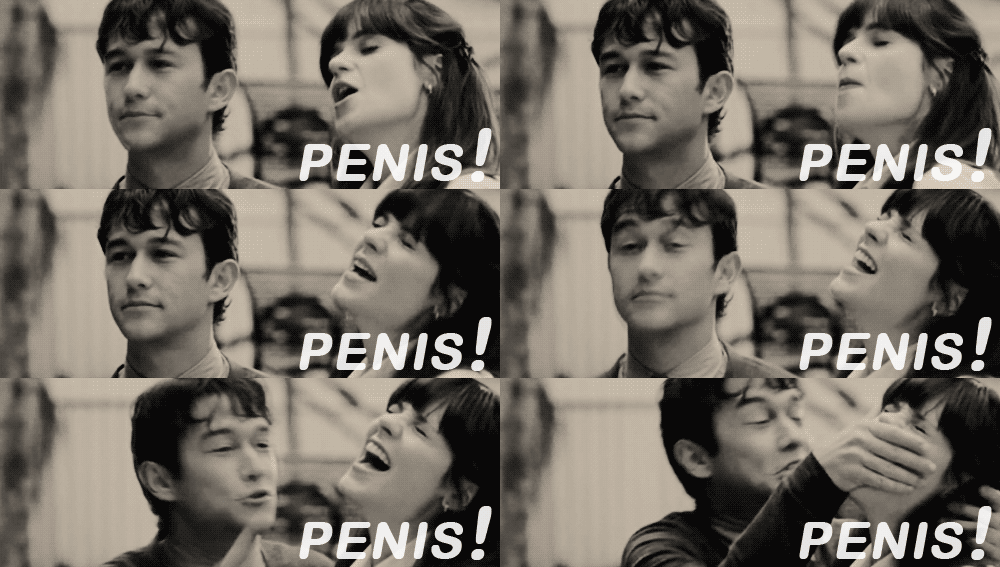
Zoey Deschanel plays Summer Finn, the love interest of Tom. This film, as it says at the start, is a story about love, not a love story. I respected Summer's character at the start of the film, so what if she was uncommitting? she was pretty and fun, she liked The Smiths!
Tom falls in love with her, they start a sort of undefined relationship. If they had facebook it would probably “complicated”. But then she dumps him and gets engaged with out telling him. He's distraught, we're distraught, bring out the Kleenex. I mean what happened to the happy ending? Why did I expect a happy ending?... awkward.
However Tom does move on and his encounter with Summer does make him quit his job and start one he actually likes and meet a new girl... reasonably called “Autumn”. But at the end of the film the general consensus is we hate her and we are left screaming questions like HOW COULD SHE DO THAT? BAD, NAUGHTY HORRID FEMINISTY MANIC PIXIE DREAM GIRL!

But wait.

She fell in love with someone else after they broke up. Its not a crime. I now realise how much of the film we were seeing through his eyes. Why does it surprise us so much that she had another path in life and decided to follow it. Yes I agree she should have told him! But I actually respect her, even though that respect came through hating her first, we got to see a small side of the manic pixie dream girl, a side that didn't go with Tom and the happy ending but oh well... she did what was best for her and didn't go on living a lie. A great film... but not one I'm pulling out on this leap year Valentines day :P LOL